Bradford's geology is split between two distinct worlds. Up in the Pennine foothills around Thornton, you hit dense glacial till — stiff boulder clay that can trick you into thinking it's strong, until you find a buried cobble. Down in the Aire Valley, near the city centre, the ground shifts to alluvial sands and gravels left by ancient river terraces. That contrast is exactly why we run the Standard Penetration Test in Bradford. A single borehole can cross both units, and the SPT catches the change in density or stiffness at every metre. Before we mobilise, we often pair it with a permeability field test to understand water flow through those valley gravels, which directly affects excavation dewatering plans.
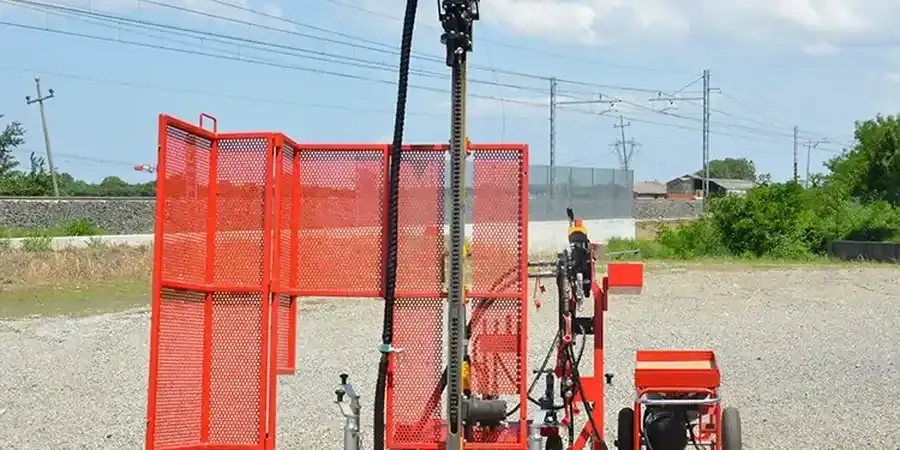
In Bradford's glacial till, a jammed split spoon is not a failure — it is a data point telling you the ground is dense and heterogeneous.
Method and coverage
Regional considerations
Eurocode 7 and BS 5930:2015 both require you to account for variable ground conditions. In Bradford, the risk is not the till — it is the hidden channel of soft alluvium beneath a site that looks uniformly firm. We have seen housing estates where one corner of a foundation sits on stiff till and the other on loose sand. The SPT catches that lateral variability. Without it, differential settlement becomes a real problem. Our engineers flag any N-value drop below 10 blows per 300 mm as a red flag for further investigation. That is where we recommend deeper probing or geophysics to map the anomaly.
Standards that apply
BS EN ISO 22476-3:2005, BS 5930:2015 (Code of practice for ground investigations), Eurocode 7 (EN 1997-2:2007)
Complementary services
Standard SPT with Continuous Sampling
Split spoon sampling at 1.0 m intervals with full N-value recording. Suitable for till, alluvium, and made ground. Includes field logs and SPT correction factors.
SPT with Hammer Energy Measurement
We instrument the hammer with an energy calibrator to measure ERi. This gives you corrected N60 or N1,60 values for liquefaction assessment or advanced settlement analysis.
SPT in Confined Urban Sites
Low-headroom rigs and reduced hammer drop for cellars, basements, or narrow access in central Bradford. Same BS EN standard, adapted for tight spaces.
Typical parameters
Top questions
How much does an SPT cost in Bradford?
A typical Standard Penetration Test in Bradford costs between £460 and £510 per test point, including mobilisation within the city boundary. Volume discounts apply for multiple boreholes on the same site.
What N-value indicates good ground in Bradford's glacial till?
In Bradford's glacial till, N-values above 30 are common in the dense boulder clay. Values between 10 and 25 suggest medium-dense till or sandy alluvium. Below 10, we flag potential soft ground requiring deeper investigation.
Do you correct SPT N-values for rod length in deep boreholes?
Yes. BS EN ISO 22476-3 requires correction for rod lengths above 10 m. We apply the standard correction factor (CN) and also correct for overburden pressure when calculating N1,60 for liquefaction analysis.