Bradford sits on a varied geological sequence of Carboniferous Millstone Grit and Coal Measures, overlain by glacial till and alluvial deposits along the Aire Valley. At an elevation of roughly 130 m above sea level, the city experiences a temperate maritime climate with annual rainfall above 800 mm, which saturates the upper soil layers and influences pore pressures significantly. The Flat Dilatometer Test (DMT) provides a rapid, repeatable method for measuring in‑situ horizontal stress, stiffness, and consolidation characteristics in these heterogeneous ground conditions. Combining DMT data with a thorough soil classification survey gives engineers a complete picture of the subsurface before foundation design begins.
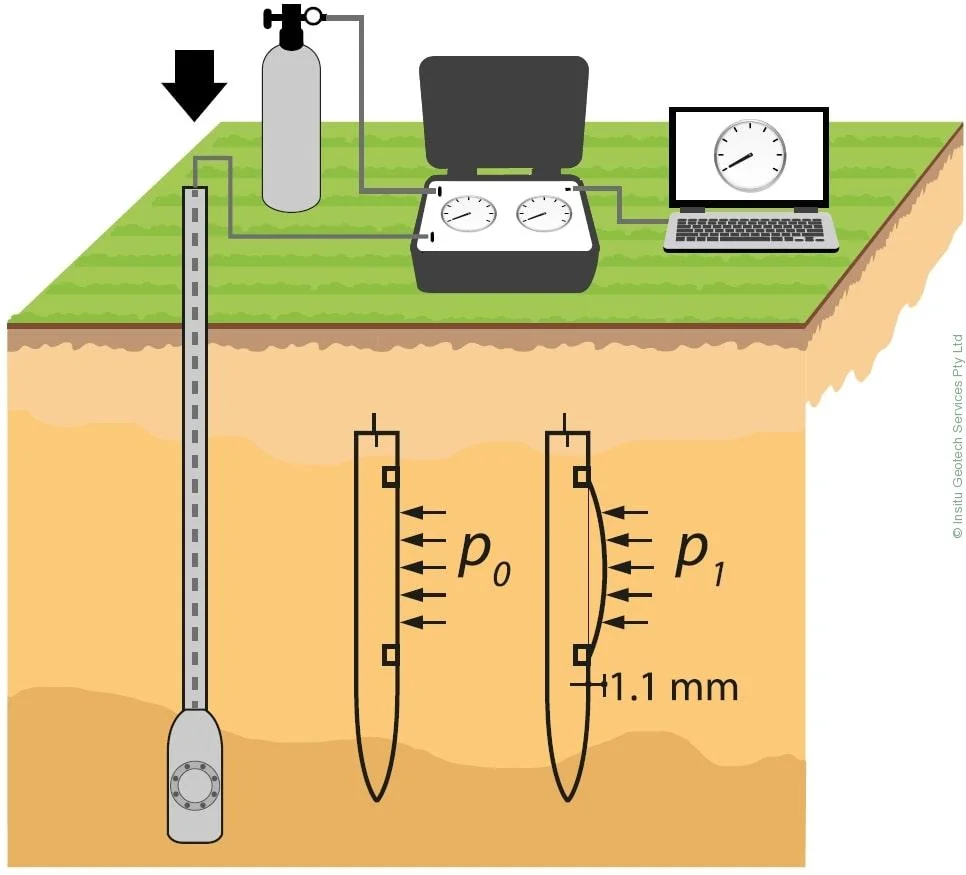
The DMT measures horizontal stress and stiffness in situ, giving direct input for settlement and lateral earth pressure design in Bradford’s variable glacial tills.
Method and coverage
Regional considerations
The Pennine foothills surrounding Bradford create sharp contrasts in drainage and groundwater levels. After prolonged wet periods, the glacial till can soften, reducing its dilatometer modulus and increasing the risk of differential settlement under shallow footings. The DMT’s ability to measure the material index (Id) and the horizontal stress index in a single push means engineers can identify overconsolidated crusts versus softer underlying zones. This is particularly relevant for developments on the city’s eastern slopes, where historical quarry backfill and colluvium add further variability.
Standards that apply
BS EN ISO 22476-11‑01 (Standard Test Method for Performing the Flat Plate Dilatometer), Eurocode 7 (EN 1997‑1:2004) – Geotechnical design using DMT parameters, BS 5930:2015 – Code of practice for ground investigations, Marchetti (1980) – In Situ Tests by Flat Dilatometer
Complementary services
Standard DMT Profiling
Continuous push profiling at 20 cm intervals to depths up to 30 m. Provides Id, Kd, Ed, constrained modulus, and undrained shear strength. Ideal for site‑wide characterisation of glacial till and made ground.
DMT for Lateral Earth Pressure Design
Focused testing in stiff overconsolidated clays to measure K0 and horizontal stress. Data used directly for retaining wall and basement wall design per Eurocode 7. Includes on‑site interpretation and preliminary design charts.
DMT for Settlement Analysis
Combined DMT and oedometer correlations to estimate immediate and consolidation settlements in Bradford’s alluvial and till sequences. Results cross‑checked with laboratory index tests for reliability.
Typical parameters
Top questions
How does the Flat Dilatometer Test differ from the SPT in Bradford soils?
The SPT gives a blow count (N‑value) that correlates with relative density and shear strength, but it is a dynamic test that disturbs the soil. The DMT is a static, strain‑controlled expansion that measures horizontal stress, stiffness, and consolidation properties directly. In Bradford’s overconsolidated glacial tills, the DMT provides more reliable modulus values for settlement calculations.
What ground conditions in Bradford are best suited for DMT testing?
The DMT works well in fine‑grained soils (clays, silts) and sands up to gravel size. In Bradford, it is particularly effective in the glacial till (boulder clay) that underlies much of the city, as well as in the alluvial deposits along the Aire Valley. It can also be used in made ground, though careful interpretation is needed due to heterogeneity.
How much does a DMT survey in Bradford typically cost?
A standard DMT profile to 15 m depth, including mobilisation, data acquisition, and a basic interpretation report, typically ranges from £700 to £710. Costs can vary depending on access constraints, number of test points, and the need for additional laboratory testing. Contact us for a site‑specific quotation.