Bradford sits on a varied mix of glacial till, alluvial deposits along the Aire and Calder valleys, and weathered Millstone Grit bedrock. In our experience, many local developers underestimate how these layers respond under earthquake loading. A proper site response analysis is essential to predict ground motion amplification, especially where soft soils overlay stiff rock. We combine shallow shear-wave velocity profiling with deeper borehole data to build a reliable soil column model. This feeds directly into the seismic design parameters required by Eurocode 8 and the National Annex. Before we run the full analysis, we often recommend a MASW survey to map Vs30 across the site efficiently, and a microtremor HVSR measurement to identify the fundamental resonance frequency of the deposit.
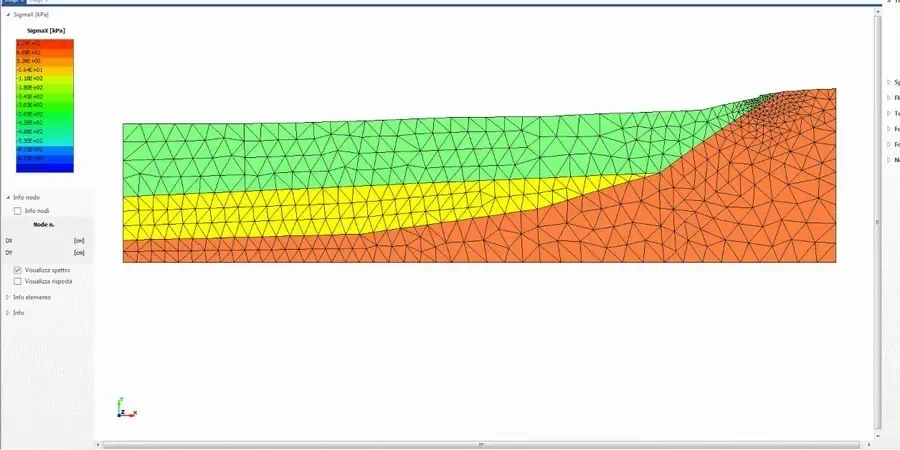
In Bradford, legacy fills and glacial till create a seismic amplification pattern that standard code methods rarely capture without site-specific analysis.
Method and coverage
Regional considerations
Bradford lies in a low-to-moderate seismicity region of the UK, but the 2008 Market Rasen earthquake (magnitude 5.2) was felt across West Yorkshire and reminded us that even moderate shaking can damage unreinforced masonry and older buildings. The main risk in Bradford comes from soft alluvial soils and loose fills that amplify long-period motion. A site response analysis identifies whether a given plot will see ground motion 2 to 3 times higher than the rock reference. Without this study, foundations may be underdesigned for the actual shaking, or overdesigned unnecessarily. We also assess potential lateral spreading in the floodplain areas near the River Aire.
Standards that apply
Eurocode 8 – BS EN 1998-1:2004 (design of structures for earthquake resistance), NEHRP Recommended Provisions (FEMA P-1050) – site classification based on Vs30, BS EN 1997-1:2004 + A1:2013 (geotechnical design – Eurocode 7), NCEER 1997 / Youd & Idriss 2001 – liquefaction evaluation procedures
Complementary services
Equivalent-Linear Ground Response Analysis
We apply the SHAKE or STRATA code to propagate input motion through a layered soil column. Shear-wave velocity profiles come from MASW or downhole surveys. Output includes acceleration response spectra, amplification factors, and strain-compatible moduli.
Nonlinear Time-History Analysis
For critical structures like hospitals or schools, we run full nonlinear analyses using DEEPSOIL or FLAC. The model captures pore pressure build-up and modulus degradation cycle-by-cycle. This is the most rigorous approach for Bradford's softer deposits.
Liquefaction Hazard Screening
We evaluate liquefaction susceptibility using SPT, CPT, and Vs-based methods per NCEER 1997. The output includes factor-of-safety profiles and post-liquefaction settlement estimates. Essential for sites near the Aire floodplain or shallow water table.
Site Classification per NEHRP / Eurocode 8
We measure Vs30 via MASW or ReMi to assign the correct site class (A through F). This directly sets the elastic response spectrum for structural design. We also check for topographic amplification on Bradford's steeper valley sides.
Typical parameters
Top questions
What is site response analysis, and why does Bradford need it?
Site response analysis calculates how local soil layers modify earthquake ground motion before it reaches the foundation. In Bradford, the mix of glacial till, alluvium, and made ground can amplify shaking by 1.5 to 2.8 times compared to rock. Without this analysis, a structure may be designed for the wrong level of shaking, risking damage or unnecessary cost.
How much does a site response analysis cost in Bradford?
A typical site response analysis for a small development plot in Bradford ranges from £940 to £3,040, depending on the number of boreholes, depth of profiling, and whether you need equivalent-linear or nonlinear modelling. We provide a fixed-price quote after reviewing the site's geology and project requirements.
What data do you need from me to start the analysis?
We need borehole logs (depth, soil description, SPT N-values), shear-wave velocity data (MASW or downhole), and the design bedrock acceleration from Eurocode 8. If you don't have Vs measurements, we can run a MASW survey on site. For existing builds, we also need the structural period to check resonance.
Does the UK have earthquakes strong enough to need this study?
Yes. The UK experiences around 200 earthquakes per year, most too small to feel, but events like the 2008 Market Rasen magnitude 5.2 caused chimney and wall damage across Yorkshire. Eurocode 8 requires site-specific response analysis for certain structures in seismic zones 2 and above. Bradford falls into zone 2 under the UK National Annex.
How long does a site response analysis take?
A standard equivalent-linear analysis with existing data takes 1 to 2 weeks. If we need to run a MASW survey first, add another week for field work and processing. Nonlinear time-history analyses take longer, typically 2 to 3 weeks, depending on model complexity and the number of input motions.