Ground improvement in Bradford represents a critical branch of geotechnical engineering that addresses the inherent challenges posed by the region's complex soil conditions. This category encompasses a suite of specialised techniques designed to enhance the engineering properties of weak or problematic soils, ensuring that they can safely support structures ranging from residential developments to major infrastructure projects. In a city with Bradford's industrial heritage and ongoing regeneration, the need for robust ground improvement is paramount, as it mitigates risks such as excessive settlement, slope instability, and bearing capacity failure. By modifying soil characteristics through methods like compaction, reinforcement, or chemical stabilisation, engineers can transform marginal sites into viable building land, directly supporting the city's economic growth and housing targets.
Bradford's geology is dominated by the Carboniferous Millstone Grit series, which comprises interbedded sandstones, siltstones, and mudstones. However, the area is also extensively mantled by superficial deposits of glacial till, alluvium, and peat, particularly in valley bottoms along the Bradford Beck and its tributaries. These softer soils, often saturated and compressible, are notorious for causing differential settlement in structures. Furthermore, the region's history of coal mining and quarrying has left a legacy of made ground and backfilled excavations, which are highly variable in composition and density. Understanding these local conditions is essential for selecting appropriate improvement strategies, as a one-size-fits-all approach is rarely effective. For projects dealing with peat or highly organic layers, a targeted organic soil management strategy is often the first step in the design process.
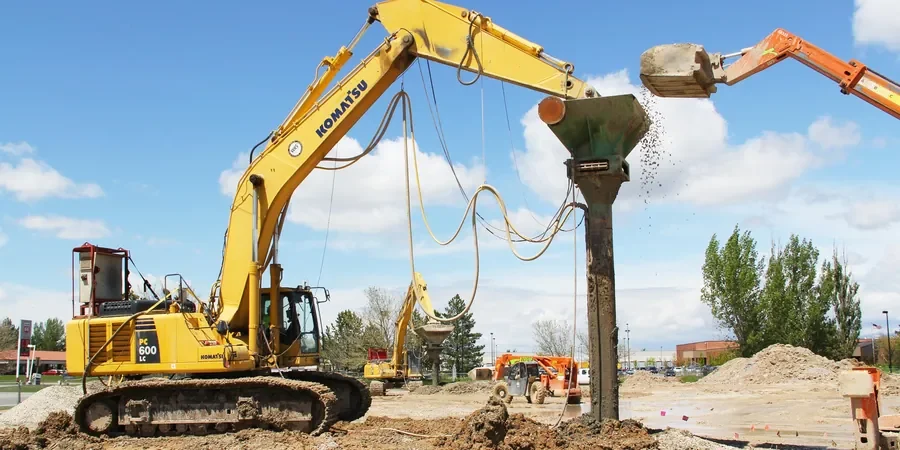
The regulatory framework governing ground improvement in the UK is stringent, ensuring that all works meet high safety and performance standards. All designs and executions must comply with Eurocode 7 (Geotechnical Design), specifically BS EN 1997-1:2004+A1:2013 and its UK National Annex, which outlines limit state design principles. Key guidance also comes from BS 8004:2015, the code of practice for foundations, and BS 6031:2009 for earthworks. For improvement techniques involving grouting, reference to BS EN 12715:2020 is essential. The NHBC Standards provide additional requirements for residential developments, particularly Chapter 4.2 on building near trees. Environmental considerations are equally critical, with the Environment Agency requiring permits for any works that may affect groundwater, a common factor in dewatering or grouting operations. Adherence to these standards is not optional; it is the legal and professional benchmark for every project.
The types of projects in Bradford that necessitate ground improvement are diverse. Large-scale commercial developments on former industrial brownfield sites routinely require comprehensive solutions to deal with made ground and potential contamination. Residential schemes on the city's steep valley sides often need preloading with surcharge design to pre-consolidate soft alluvium and prevent post-construction settlement. Infrastructure projects, such as road widenings or new flood alleviation schemes along the River Aire, frequently encounter saturated silts and clays where a detailed unsaturated soil analysis is crucial for predicting long-term behaviour. For containment and environmental protection, such as in landfill capping or canal lining, a robust geomembrane specification is vital. Even smaller projects, like house extensions, can be affected by shrinkable clays, where a deep understanding of soil improvement through grouting design can prevent costly structural damage.
Common questions
What is the main purpose of ground improvement in construction?
Ground improvement aims to modify the physical and mechanical properties of in-situ soils to meet specific engineering requirements. This involves increasing bearing capacity, reducing compressibility and settlement, mitigating liquefaction potential, and controlling groundwater flow. The ultimate goal is to create a stable, durable foundation medium that safely supports structures without excessive movement or failure over their design life.
How do I know if my Bradford site requires ground improvement?
A comprehensive geotechnical site investigation is the definitive way to determine the need for improvement. Key indicators include the presence of soft clays, loose sands, peat, or made ground in exploratory boreholes. If the soil's allowable bearing capacity is lower than the structural loads, or predicted settlements exceed tolerable limits, ground improvement becomes essential. Local knowledge of Bradford's alluvial valleys and industrial fill areas is a strong preliminary warning sign.
What are the most common ground improvement techniques used in the UK?
Common techniques in the UK include dynamic compaction, vibro stone columns, deep soil mixing, permeation grouting, and surcharge preloading. The choice depends on soil type, depth of improvement required, and project constraints. For example, vibro replacement is effective for soft cohesive soils, while grouting is suited for granular soils or rock fissures. The method must be selected based on a rigorous design process compliant with BS EN 1997.
How long does a typical ground improvement process take?
The duration varies significantly based on the technique, site size, and soil conditions. A small-scale surcharge preloading scheme might require several months for consolidation to occur, while a vibro stone column installation for a large warehouse can be completed in a matter of weeks. The design phase, including soil analysis and method specification, also adds time upfront but is crucial for a successful and predictable programme.