In Bradford, the mix of Millstone Grit and Coal Measures mudstone creates slopes that behave differently depending on orientation and drainage. We've seen many retaining wall failures and shallow landslides on the steeper hillsides near the city centre, often because the clay layers soften after prolonged rain. A proper slope stability analysis identifies the critical failure surface and the factor of safety against sliding, which is essential before any cut or fill operation. We combine field observations with laboratory triaxial tests and pore pressure monitoring to model realistic conditions. For deeper cuts we also run MASW-Vs30 profiles to capture stiffness variations in the weathered zone.
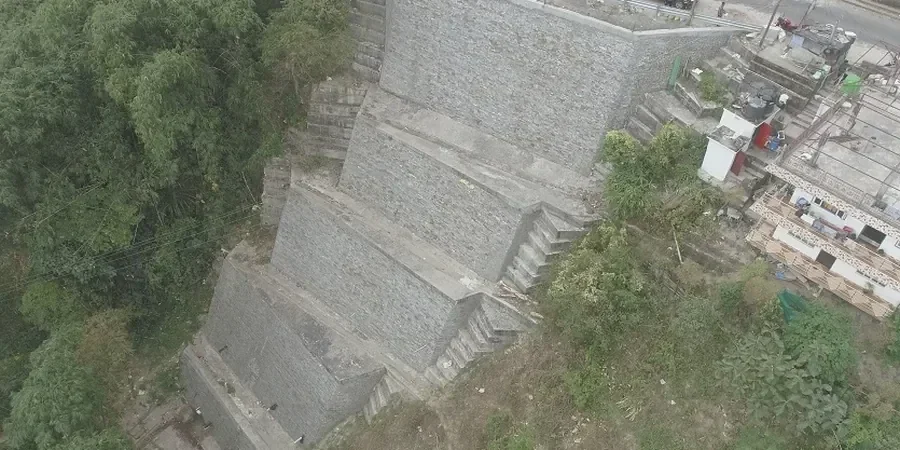
Rainfall-induced pore pressure rise in Coal Measures clay can halve the factor of safety within 48 hours.
Method and coverage
Regional considerations
The wet Pennine climate means Bradford slopes stay near saturation for months. That's the main trigger for instability: a sudden heavy downpour after a wet spell raises pore pressure enough to reduce effective stress on the shear plane. We've mapped several slow-moving landslides in the Thornton and Queensbury areas where the failure surface sits within the weathered mudstone. Without a site-specific slope stability analysis, cuts for new roads or housing platforms can reactivate these ancient slides. We always install standpipes or vibrating-wire piezometers to track pore pressure changes across the seasons before finalising our models.
Standards that apply
BS 5930:2015 Code of practice for ground investigations, Eurocode 7 – EN 1997-1:2004 Geotechnical design, BS EN 1997-2:2007 Ground investigation and testing, FHWA-NHI-05-089 (for reinforced slopes if applicable)
Complementary services
Field Investigation & Instrumentation
Rotary boreholes, trial pits, and installation of piezometers and inclinometers to measure pore pressure and subsurface movement. We also collect undisturbed samples for laboratory testing.
Numerical Modelling & Limit Equilibrium Analysis
Using Slide2 and Plaxis 2D for both simple circular failures and complex non-circular surfaces. We model multiple scenarios: long-term drained, short-term undrained, and seismic loading.
Remediation Design & Verification
Design of drainage systems, soil nails, retaining walls, or geogrid-reinforced slopes. We check the post-construction factor of safety and monitor performance for at least one wet season.
Typical parameters
Top questions
When do I need a slope stability analysis in Bradford?
If you are planning any cut or fill steeper than 1:3 (about 18 degrees), or working within 15 m of an existing slope, a stability analysis is strongly recommended. Bradford's Coal Measures clay can lose strength rapidly when exposed, especially during winter.
How much does a slope stability analysis cost?
A typical geotechnical assessment for a single slope in Bradford ranges between £1.100 and £2.870, depending on borehole depth, number of laboratory tests, and modelling complexity. We provide a fixed-price quote after a site walkover.
What is the difference between long-term and short-term stability?
Short-term stability refers to undrained conditions just after excavation, where clay has no time to drain. Long-term stability considers drained conditions with steady-state pore pressure. In Bradford's mudstones, the long-term factor of safety is usually lower and governs design.
Can you analyse a slope that already shows signs of movement?
Yes. We install inclinometers to track movement rate and depth of the shear surface. Combined with back-analysis using residual shear strength, we can determine whether the slide is active or dormant and design appropriate stabilisation measures.
Which software do you use for the analysis?
We use Slide2 (Rocscience) for limit equilibrium and Plaxis 2D for finite element modelling. Both are widely accepted by UK building control and comply with Eurocode 7 requirements for slope stability verification.