Bradford grew fast during the Industrial Revolution, its mills and terraced housing climbing the steep valleys of the Aire and Calder catchments. Much of that 19th-century expansion happened on glacial till overlying Millstone Grit and Coal Measures, creating a varied seismic response across the city. For modern infill and redevelopment projects, understanding the natural frequency of the ground is critical. An HVSR microtremor survey (Nakamura method) measures ambient vibration to identify soil resonance, helping engineers avoid structural amplification during an earthquake. Before committing to deep foundations, many teams combine this passive survey with a resistivity survey to map lateral variability, or a [MASW profile](/masw-vs30/) for shear-wave velocity, ensuring the dynamic model reflects Bradford's actual subsurface.
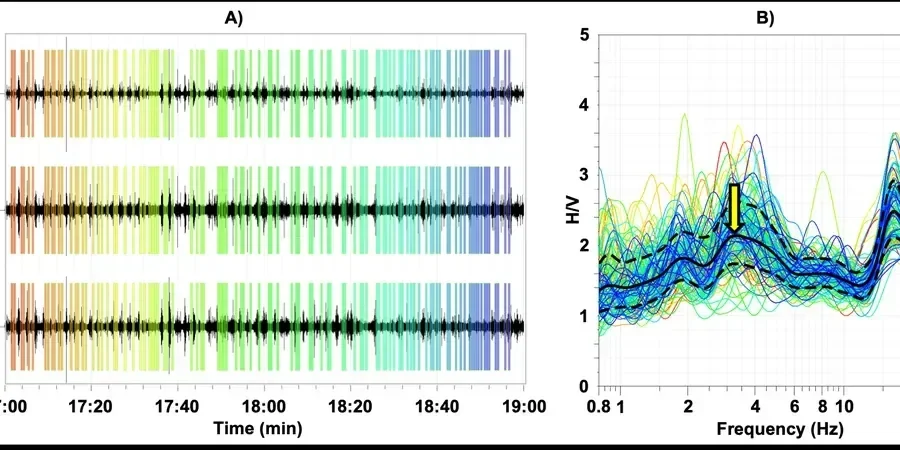
A single HVSR station can classify a site in under an hour, revealing whether the ground will amplify or dampen seismic waves during an event.
Method and coverage
Regional considerations
The HVSR microtremor survey (Nakamura method) uses a compact seismometer and a laptop — no drilling, no heavy plant. In Bradford's narrow Victorian streets and conservation areas, that is a real advantage. The sensor sits on a levelled patch of ground, often inside a building footprint, and records for about an hour. Traffic, wind, and nearby machinery can contaminate the signal, so the technician selects quiet periods and applies anti-trigger filters. Post-processing removes transient noise using short-time Fourier transforms. The result is a clean H/V curve that directly indicates the soil's fundamental period.
Process video
Standards that apply
SESAME Guidelines (2004) – Site Effects Assessment Using Ambient Excitations, Eurocode 8 (BS EN 1998-1:2004) – Seismic site classification via f₀, NEHRP Recommended Provisions (2020) – Soil profile type correlation
Complementary services
Single-Station HVSR (standalone)
Ideal for small infill plots or quick site class checks. One seismometer, one hour of recording, and a report with f₀, peak amplitude, and EC8 site class recommendation.
Multi-Point HVSR Grid
For larger developments or brownfield sites with variable drift. We deploy a grid of 8–20 stations to map lateral changes in soil resonance across the site.
HVSR + MASW Combination
Combining passive HVSR with active MASW gives both f₀ and shear-wave velocity (VS30). This dual approach meets the most stringent requirements for seismic design in Bradford.
Typical parameters
Top questions
What does an HVSR microtremor survey measure?
It measures ambient ground vibrations (microtremors) from natural and human sources. The Nakamura method computes the horizontal-to-vertical spectral ratio (H/V) to identify the fundamental resonance frequency of the soil column. This tells you how the ground will behave during an earthquake.
How long does an HVSR survey take in Bradford?
A single station takes about one hour of recording plus setup. A typical 10-station grid across a Bradford site can be completed in one to two days, with results delivered within five working days.
What is the cost of an HVSR microtremor survey in Bradford?
The price range for a professional HVSR survey in Bradford is £1,170 to £1,800, depending on the number of stations and level of interpretation. Contact us for a fixed quote based on your site area and access conditions.
Can HVSR replace boreholes for seismic site classification?
Not entirely, but it reduces the number of boreholes needed. HVSR gives the fundamental frequency and helps target borehole locations. For Eurocode 8 classification, we usually recommend combining HVSR with at least one borehole or MASW profile for VS30.
What equipment is used for the Nakamura method?
We use a three-component broadband seismometer (flat response from 0.2 to 100 Hz) connected to a 24-bit digitiser. The setup is battery-powered and fits in a backpack, making it ideal for Bradford's tight urban sites and pedestrianised areas.