The field crew unspools a multi-core cable across the grass near Lister Park. Electrodes are hammered into the damp ground at precise intervals. A resistivity meter sends a low-frequency current through the soil. This is how Vertical Electrical Sounding (VES) works in Bradford. The instrument records voltage drops between potential electrodes. Each reading reveals a layer's true resistivity. The data builds a vertical profile of the subsurface. This method is non-invasive and fast. It avoids drilling in sensitive areas like the city centre or Green Belt sites. The team runs multiple soundings to cover the site area. Results help engineers decide where to dig next. Many projects in Bradford start with a resistivity survey before any drilling. It saves time and money by targeting only critical zones.
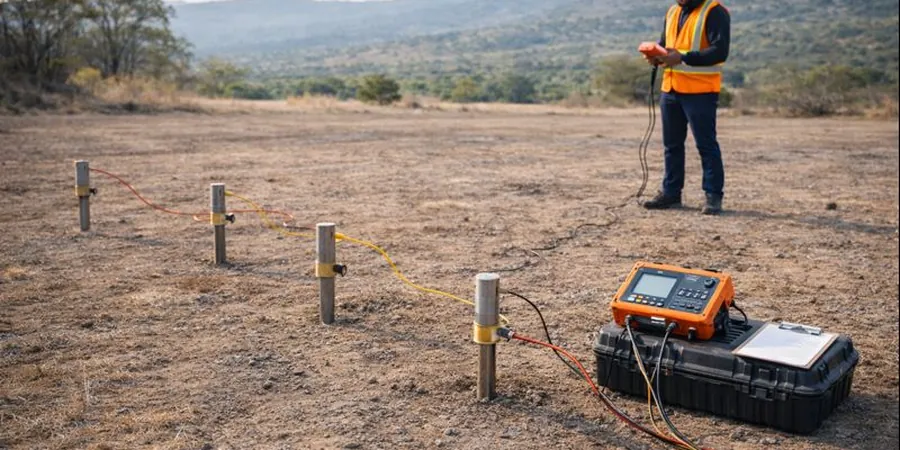
Resistivity surveys in Bradford detect buried voids, mine workings, and saline groundwater without a single borehole – saving time and reducing risk.
Method and coverage
Regional considerations
A housing development near Thornton Road sits on variable glacial till. One corner of the site has stiff clay. The other corner has loose sand with high groundwater. A resistivity survey reveals the transition between these two materials. Without it, the design would assume uniform ground. That assumption leads to differential settlement. The risk is real in Bradford because of its complex glacial legacy. Boreholes alone might miss a sand lens. Resistivity covers the whole site. It flags problem zones early. Engineers then adjust foundation depths or specify Improvement. The cost of a survey is small compared to a structural failure. Developers in Bradford use resistivity to de-risk their projects from day one.
Standards that apply
BS 1377 Standard Guide for Using the Direct Current Resistivity Method for Subsurface Investigation, BS 5930:2015 Code of Practice for Ground Investigations, Eurocode 7 (EN 1997-1:2004) Geotechnical Design
Complementary services
Vertical Electrical Sounding (VES)
Single-point depth profiling using Wenner or Schlumberger arrays. Ideal for bed depth, water table, and contamination mapping.
2D Resistivity Imaging
Multi-electrode arrays producing a continuous subsurface cross-section. Used to map lateral changes in glacial till, fill, and bedrock.
3D Resistivity Tomography
Grid-based surveys for complex sites. Produces a volumetric model of resistivity. Useful for landfill delineation and void detection.
This service complements our laboratory testing work for a complete project analysis.
Typical parameters
Top questions
How deep can a Vertical Electrical Sounding (VES) reach in Bradford?
With a 50-metre electrode spread, a VES can resolve layers down to about 25 metres. Deeper spreads of 100 metres reach up to 50 metres. The actual depth depends on ground conductivity and noise from buried utilities common in urban Bradford.
What is the typical cost for an electrical resistivity survey in Bradford?
A standard VES survey with 10 soundings and interpretation typically ranges between £430 and £770. Larger 2D profiles or 3D grids cost more due to increased field time and data processing. Contact us for a site-specific quote.
Can resistivity surveys detect old mine workings in Bradford?
Yes. Abandoned coal mine workings from the 19th century create voids or collapsed ground. These zones have higher resistivity than the surrounding intact rock. A VES or 2D survey can locate them. The method is widely used in the Bradford district for brownfield redevelopment.