Bradford grew rapidly during the Industrial Revolution, with mills and warehouses built on the region's glacial tills and alluvial deposits along the Aire Valley. Much of the city centre sits on variable ground, where soft clays and made ground from former industrial activity create complex conditions for modern construction. A comprehensive soil mechanics study in Bradford is essential to characterise these heterogeneous soils before any foundation design begins. The presence of old mine workings and backfilled quarries in the outskirts further complicates the ground model, requiring detailed borehole investigation and laboratory classification. Without a dedicated study, the risk of differential settlement or bearing failures increases sharply in this urban setting.
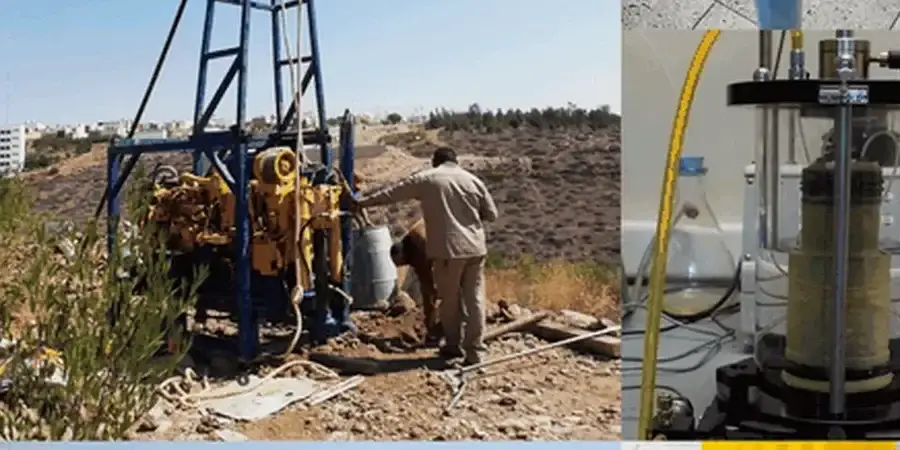
The variable glacial till sequence beneath Bradford requires careful profiling to avoid differential settlements in new developments.
Method and coverage
Regional considerations
A common mistake among developers in Bradford is relying solely on existing geological maps without commissioning a site-specific soil mechanics study. The glacial till varies laterally from a stiff clay to a soft sandy silt within the same street block, especially near former mill ponds and canal basins. When builders assume uniform ground and proceed with standard strip footings, they often encounter excessive settlement during the first winter. The saturated made ground along the Leeds and Liverpool Canal corridor introduces additional risk of long-term consolidation. A targeted investigation avoids these failures by identifying the actual shear strength and compressibility before construction begins.
Standards that apply
BS 5930:2015 – Code of practice for ground investigations, Eurocode 7 (BS EN 1997-1:2004) – Geotechnical design, BS 5930 – Description and identification of soils (visual-manual procedure)
Complementary services
Field Sampling and In-Situ
We execute cable percussive boreholes and window sampling to recover disturbed and undisturbed samples from the glacial till and alluvial layers. In-situ SPT and hand shear vane tests are conducted at regular depth intervals to measure strength and stiffness directly on site.
Laboratory Classification and Strength Tests
Index tests including moisture content, Atterberg limits and particle size distribution are performed on every sample. Triaxial compression tests (UU and CIU) on undisturbed specimens determine the effective stress parameters required for bearing capacity and slope stability analysis.
Typical parameters
Top questions
Why is a soil mechanics study necessary for a housing development in Bradford?
Bradford's ground is highly variable due to glacial till, made ground from industrial activity and alluvial deposits near the Aire. Without a study, differential settlements and bearing failures are likely, especially on sites with old foundations or backfilled ground. The investigation identifies the actual strength and compressibility of each stratum.
What is the typical cost range for a soil mechanics study in Bradford?
For a standard residential plot, the cost ranges between £2.400 and £4.510 depending on the number of boreholes, depth of investigation and laboratory tests required. Larger commercial sites with deeper boreholes and advanced triaxial testing fall at the higher end.
How deep do boreholes need to be for a soil mechanics study in Bradford?
For low-rise housing, boreholes typically extend to 5–8 metres to penetrate the full thickness of glacial till and confirm the bedrock profile. On sites near former mine workings or deep made ground, depths of 12–15 metres are necessary to reach competent strata. The requirement is assessed during the desk study phase.