A common mistake we see on Bradford sites is specifying a geomembrane thickness based solely on the project budget rather than the actual ground conditions. The Pennine foothills around Bradford present variable subgrade — from stiff glacial till to soft alluvial deposits along the Aire valley. If the subgrade settlement potential is underestimated, even a 1.5mm HDPE liner can rupture under service loads. That is why our team always pairs the geomembrane specification with a proper assessment of settlement risks before finalising the material grade. We run index tests and confirm the design tensile properties against site-specific deformation demands.
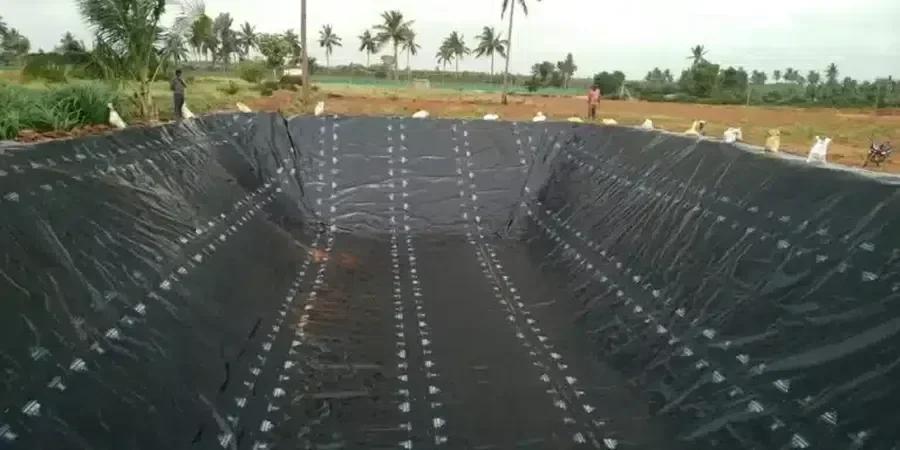
A geomembrane is only as reliable as the subgrade it rests on; differential settlement in Bradford's glacial tills can tear a 1.5mm liner if not accounted for in the specification.
Method and coverage
- Review of the site investigation borehole logs and settlement analysis.
- Selection of polymer type (HDPE, LLDPE, fPP) based on chemical exposure and UV resistance.
- Definition of seam strength, factory and field testing frequency per GRI-GM19.
- Integration with the overall slope stability design for lined slopes steeper than 1:3.
Regional considerations
Bradford receives over 800 mm of rainfall annually, and the high water table in low-lying areas adjacent to the Leeds & Liverpool Canal creates persistent uplift pressures beneath lined basins. If the geomembrane specification does not include an adequate ballast or anchor trench design, buoyancy forces can lift the liner during heavy rain events. We have witnessed failed installations where a 1.0mm smooth liner was pulled from its trench because the overburden was insufficient. Our protocol integrates the anchor system with the subgrade drainage and erosion control design to guarantee long-term stability.
Standards that apply
BS EN 1997-1:2004 (Eurocode 7), GRI-GM13 (HDPE geomembrane standard), BS 5930:2015 (Code of practice for ground investigations), GRI-GM19 (seam strength testing)
Complementary services
Material selection and index testing
Laboratory testing of tensile, tear, puncture, and seam strength per ASTM and GRI standards. We verify the polymer formulation and carbon black dispersion to ensure long-term durability in Bradford's climate.
Subgrade compatibility assessment
Evaluation of the prepared subgrade surface, including particle size distribution, compaction levels, and chemical compatibility. We issue a written recommendation for cushion geotextile or drainage layer thickness.
Installation quality assurance (CQA)
On-site supervision of panel deployment, seam welding, non-destructive and destructive seam testing. We produce a final CQA report accepted by the Environment Agency and local planning authorities in West Yorkshire.
Typical parameters
Top questions
What is the typical cost range for a geomembrane specification study in Bradford?
For a standard landfill or lagoon liner project in the Bradford area, a full specification study including laboratory testing and CQA planning ranges between £460 and £1,210. The final figure depends on the number of polymer samples, the complexity of the seam configuration, and the need for site-specific subgrade testing.
Which geomembrane thickness is recommended for a landfill cap in the Pennine foothills?
For capping applications on the sloping ground typical of Bradford's western suburbs, a 1.5mm textured HDPE geomembrane is the minimum standard. The texture improves interface friction with the overlying drainage layer and cover soil, reducing the risk of sliding on slopes steeper than 1:3.
How do I know if the subgrade beneath my lagoon liner is stable enough for a geomembrane?
We require the results of a site investigation including boreholes and plate load tests. The subgrade should achieve a California Bearing Ratio (CBR) of at least 3% after compaction; softer ground requires a geotextile cushion and a thicker geomembrane (≥2.0mm). Our geotechnical report will specify the exact preparation works needed.