The soils beneath Bradford’s city centre, around the historic Kirkgate area, are predominantly glacial till with stiff clays, whereas the southern suburbs near Queensbury sit on weathered Millstone Grit with much looser, fractured bedrock. That contrast means a single geophysical approach won’t work across the whole city. We use MASW (Multichannel Analysis of Surface Waves) to map shear wave velocity profiles that reflect those local differences. Before designing foundations on the variable ground in Bradford, combining MASW with a georradar survey helps identify shallow voids and buried structures that could affect wave propagation.
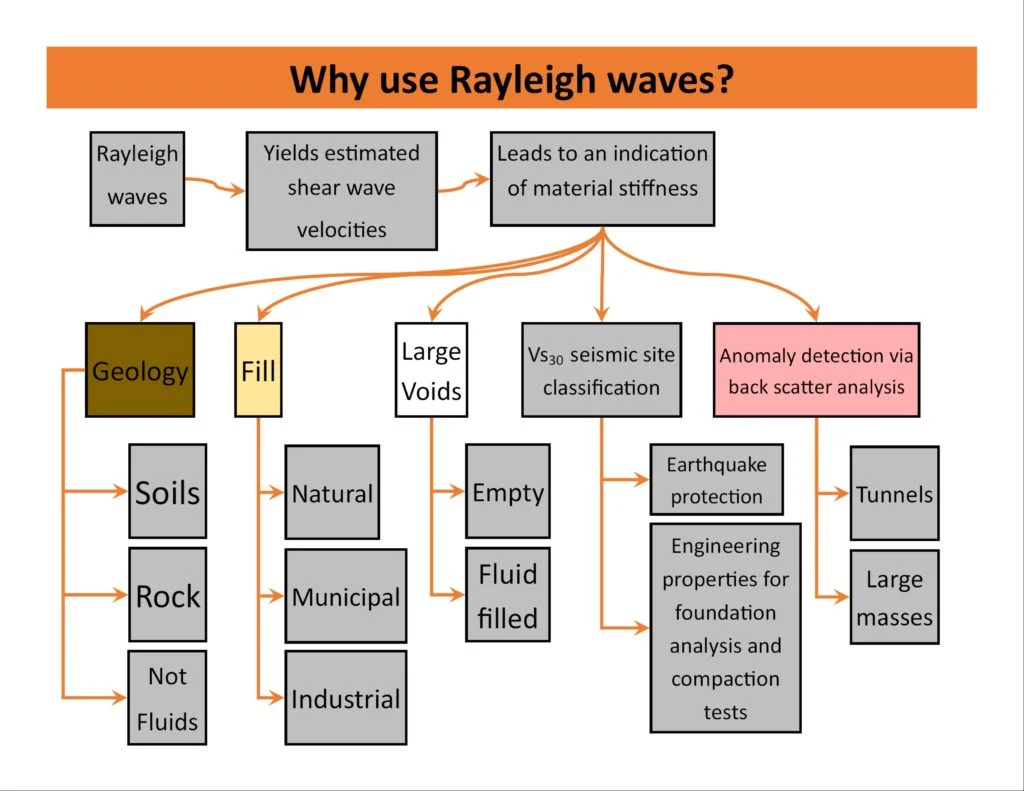
MASW gives a continuous velocity profile without boreholes, crucial for mapping stiff till over softer weathered zones in Bradford’s glacial deposits.
Method and coverage
Regional considerations
The MASW equipment we deploy in Bradford weighs about 180 kg including the seismograph, cables and geophones. On the steep slopes above Thornton, we often have to hand-carry it up narrow footpaths because vehicle access is limited. That physical constraint means we plan each survey line carefully to minimise dead time between shots. The main risk is data contamination from nearby traffic or industrial vibration – Bradford’s ring road and the M606 corridor create constant low-frequency noise. We mitigate this by stacking 10–15 shots per location and applying a bandpass filter between 2 and 80 Hz during processing.
Standards that apply
BS 1377 – Standard Test Methods for Crosshole Seismic Testing, NEHRP Recommended Provisions (FEMA P-1050) – Site classification based on VS30, Eurocode 8 (BS EN 1998-1:2004) – Soil type classification using shear wave velocity
Complementary services
2D MASW Profile
Linear array survey producing a 2D shear wave velocity section. Typically 50–100 m long, with 1 m receiver spacing. Delivered as a colour-contour plot and ASCII velocity-depth table. Ideal for mapping lateral variations in till and bedrock across development sites in Bradford.
VS30 Site Classification
Focused measurement of the time-average shear wave velocity in the top 30 m. We deploy a single MASW line centred on the borehole location and compute VS30 per NEHRP class A–F. Includes a written report with the velocity profile and site class assignment for seismic design.
MASW with Active and Passive Sources
Combines active sledgehammer shots with passive ambient noise recording to improve depth penetration in stiff Bradford till. Passive recording uses 10-minute windows. Useful when the target depth exceeds 25 m or when active sources cannot generate enough low-frequency energy.
Typical parameters
Top questions
What is the difference between MASW and VS30?
MASW is the field technique that measures surface wave dispersion and inverts it to a shear wave velocity profile. VS30 is a single value derived from that profile: the time-average shear wave velocity over the top 30 m. VS30 is used by Eurocode 8 and NEHRP to classify the site into seismic soil categories. We always report both the full velocity profile and the computed VS30.
How deep can MASW penetrate in Bradford’s glacial till?
In stiff glacial till, typical penetration depth with a 24-channel array and 2 Hz geophones is 15–25 m. If you need to reach 30 m or more, we add passive recording – the passive MASW extension can push depth to 40 m in favourable conditions. For deeper targets, we recommend combining MASW with a crosshole seismic survey.
What is the typical cost range for a MASW survey in Bradford?
A basic 2D MASW profile over a 50 m line costs between £1,160 and £1,750 depending on access difficulty and number of shot points. A full VS30 classification including passive recording, inversion, and a site class report ranges from £1,750 to £2,430. Prices vary with site size and the number of profiles required.
Do MASW results replace the need for boreholes?
No. MASW provides a continuous velocity profile but does not give soil samples, stratigraphy, or index properties. We recommend using MASW as a screening tool to plan borehole locations, then correlating the velocity profile with actual soil types from the borehole logs. That combined approach gives you both spatial coverage and ground truth.