Bradford's position in the Pennine foothills means we deal with a mix of glacial till, alluvial deposits, and weathered Millstone Grit. The region's high annual rainfall — around 900 mm — saturates the upper soil layers, making accurate soil classification essential before any foundation work. We apply USCS and AASHTO systems to categorise these materials, linking index properties to engineering behaviour. For example, the stiff clays common in the Aire Valley often classify as CH (high plasticity), requiring careful drainage design. Before we assign a group symbol, we run full Atterberg limits and sieve analysis. This data also feeds into a subgrade evaluation when designing road pavements, or into a plate load test to verify bearing capacity on site.
In Bradford's glacial tills, the plasticity index often exceeds 35 %, classifying as CH — a red flag for shrink-swell risk.
Method and coverage
Regional considerations
In Bradford, many times we see contractors assume that all brown clay is the same. That assumption fails when a site in Bierley hits a high-plasticity CH layer while a site in Baildon finds low-plasticity CL. The difference changes bearing pressure by a factor of two. Without proper soil classification, you risk foundation heave from expansive clay or differential settlement where soft alluvium meets stiff till. We always flag the presence of organic silt or peat lenses, common along the Bradford Beck valley, because those materials classify as OH or PT and require removal or deep foundations. That is why we insist on classification before any design proceeds.
Process video
Standards that apply
BS 5930:2015, BS EN ISO 14688-2, BS 1377-2, Eurocode 7 (EN 1997-1:2004)
Complementary services
Full USCS Classification Suite
Includes Atterberg limits, natural moisture content, and wet-sieving down to 63 µm. We deliver a group symbol, group name, and plasticity chart plot. Suitable for fine-grained soils (clay, silt) common in Bradford's residential developments.
AASHTO Soil Classification for Pavements
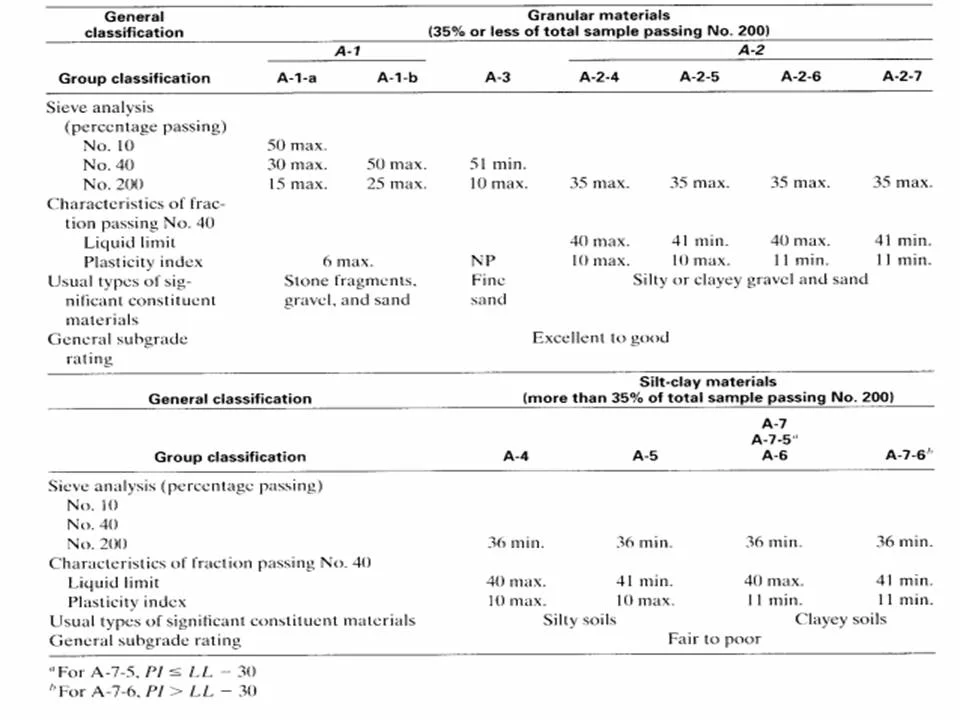
Combines sieve analysis with plasticity data to assign an AASHTO group index (GI). Used for road subgrade evaluation in highway projects like the A650 Corridor. Includes CBR correlation from the classification results.
Typical parameters
Top questions
What is the difference between USCS and AASHTO classification systems?
USCS groups soils by particle size and plasticity (e.g. CH, SM), while AASHTO groups them by suitability for road subgrade (A-1 to A-7). USCS is more common in foundation design; AASHTO is preferred for pavement engineering. Both are based on Atterberg limits and sieve analysis.
How much does a soil classification test cost in Bradford?
A standard USCS classification (Atterberg limits + sieve analysis) typically ranges between £60 and £80 per sample. The price may vary depending on the number of samples and whether additional tests like natural moisture content or organic content are required.
Why do Bradford's glacial tills classify as high-plasticity clay?
The glacial tills in the Aire Valley contain a high proportion of clay minerals (illite and kaolinite) deposited during the Devensian glaciation. Their liquid limit often exceeds 50 %, placing them in the CH group. This gives them high shrink-swell potential, which affects foundation design.
Can you classify soils on site without taking samples to the lab?
Field classification using hand tests (ribbon, thread, dilatancy) can provide a preliminary USCS group, but it is not a substitute for lab testing. For design purposes, we always recommend lab-based Atterberg limits and sieve analysis to meet BS 5930 and Eurocode 7 requirements.