Bradford sits on a mix of glacial till, alluvial deposits, and Coal Measures bedrock. That variability means shear strength can change within metres. The direct shear test is the standard method we use to measure cohesion and friction angle in these soils. For projects near the River Aire or on the steeper slopes of the city centre, this test gives us drained parameters quickly. We run it under BS 1377:1990 Part 7, with normal stresses matching expected field loads. The results feed directly into slope stability calculations and foundation bearing capacity checks. It is a simple, reliable test. We process each sample within 48 hours of arrival at our Leeds Road lab.
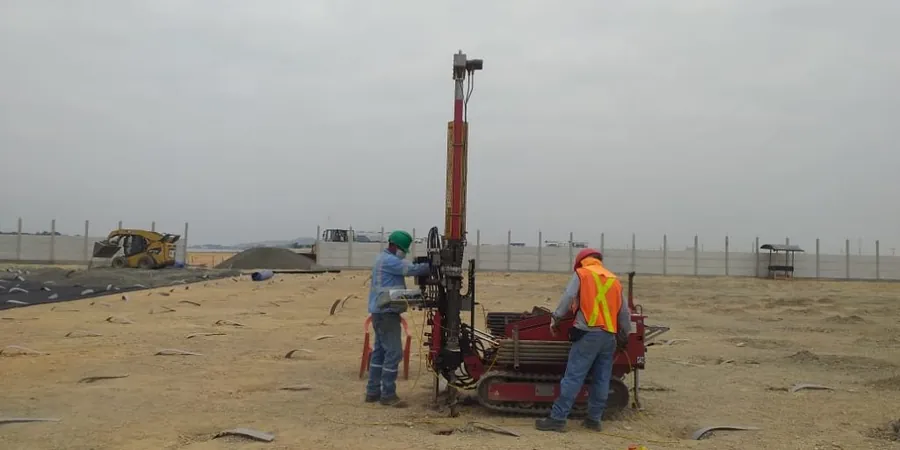
Three normal stress stages. Peak and residual envelopes. UKAS-calibrated shear box. Results in 48 hours.
Method and coverage
- Consolidated drained (CD) for long-term stability
- Consolidated undrained (CU) with pore pressure measurement
- Multi-stage testing to save sample volume
Regional considerations
Clay soils under Bradford's Victorian terraces can lose strength when saturated. The direct shear test identifies this drop. In areas like Manningham or Heaton, where the glacial till overlies shale, residual shear strength is critical. A slope that looks stable in summer can fail after a wet winter. We saw this on a housing development near Lister Park in 2023. The test revealed cohesion values 40% lower than the design assumption. That changed the retaining wall design. Ignoring the residual envelope would have meant a 1 in 15 year failure risk.
Standards that apply
BS 1377:1990 Part 7, Eurocode 7 (EN 1997-1:2004), BS 5930:2015, BS 1377-7
Complementary services
Standard Direct Shear – Cohesive Soils
Consolidated drained (CD) test on undisturbed samples from block or tube samplers. Three normal stress stages. Peak and residual friction angle and cohesion reported. Suitable for clay till and alluvial clay in Bradford.
Multi-Stage Direct Shear – Granular Soils
Single sample sheared at three different normal stresses. Reduces sample volume requirements. Ideal for sands and gravels from Bradford's river terrace deposits. Includes particle size analysis post-test.
This service complements our laboratory testing work for a complete project analysis.
Typical parameters
Top questions
How long does a direct shear test take in Bradford?
For a consolidated drained test on clay till, expect 3 to 5 days including saturation and shearing. Granular soils test faster, usually 24 to 48 hours. We prioritise projects with tight deadlines.
What is the difference between peak and residual shear strength?
Peak strength is the maximum resistance before failure. Residual strength is the lower, constant value after large displacement. In Bradford's glacial till, residual strength can be 30–50% lower than peak. This matters for slope stability and retaining wall design.
Do you accept remoulded samples for direct shear testing?
Yes. We test remoulded samples to simulate compacted fill or disturbed ground. The sample is compacted to a specified density and moisture content. We can also test at multiple densities to find the shear strength envelope for a range of compaction levels.
How much does a direct shear test cost in Bradford?
A standard single-stage direct shear test costs between £480 and £600. Multi-stage tests or tests requiring pore pressure measurement are priced higher. Contact us for a quote based on your specific scope and number of samples.