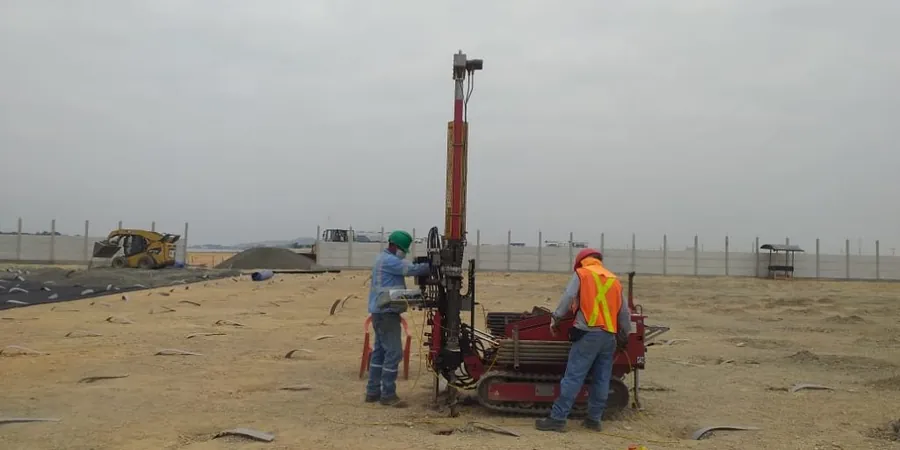
A recent extension to a Victorian terrace in the Manningham district of Bradford showed early diagonal cracking in the brickwork. The owner called us before any further movement occurred. We deployed a series of boreholes with undisturbed sampling to run oedometer tests, measuring the compression index and pre-consolidation pressure. The soil profile there is typical of the Aire Valley glacial till over laminated clays, which can present a moderate consolidation settlement risk. Before interpreting the lab results, we also ran a plate load test on site to confirm modulus of subgrade reaction, and we coupled that with a CPT sounding to capture continuous stratigraphy. The combined data allowed us to predict total and differential settlement within the tolerances required by Eurocode 7 and BS EN 1997-2.
A 3 mm differential settlement across a bay window in Bradford's clay soils can lead to irreversible fabric damage within two heating seasons.
Method and coverage
Regional considerations
Bradford lies within the Pennine foothills where annual rainfall exceeds 900 mm, and the underlying bedrock is Millstone Grit with interbedded shales. That combination drives seasonal moisture changes that can cause clay shrinkage and swelling, accelerating differential settlement. A 2020 study by the British Geological Survey highlighted that parts of the BD1 and BD2 postcodes sit on glacial till with a high shrink–swell potential. If a settlement analysis is omitted or rushed, the risk of structural distress in terraced housing and light industrial units increases significantly. Our lab data gives engineers the parameters to design foundations that tolerate these cyclic movements without cracking.
Standards that apply
BS 1377-5:1990 – Methods of test for soils (consolidation properties), BS EN 1997-2:2007 – Eurocode 7 – Ground investigation and testing, NHBC Standards Chapter 4.2 – Building near trees (shrinkable soils)
Complementary services
One-Dimensional Consolidation Test (Oedometer)
BS 1377-5 procedure on undisturbed samples. We report mv, cv, Cc and pre-consolidation pressure. Results are tabulated for immediate use in settlement calculations.
Swelling Pressure Test
For clay profiles near trees or in areas with high plasticity. We measure free swell and swelling pressure under controlled conditions, critical for foundation design in shrink-swell zones.
Finite Element Settlement Modelling
We process lab parameters into Plaxis 2D models. This helps predict total and differential settlement under strip footings, rafts or pad foundations for Bradford's variable ground.
Typical parameters
Top questions
How long does a full settlement analysis take for a Bradford residential project?
From sample arrival to final report, we typically turn around a standard oedometer suite in 10–14 working days. If swelling tests are required, add 3–5 days. We can prioritise urgent projects on request.
What is the difference between total settlement and differential settlement in a Bradford context?
Total settlement refers to the overall vertical movement of the entire foundation. Differential settlement is the variation in movement between adjacent supports, which causes the cracking often seen in Bradford's older terrace houses. Our analysis quantifies both against Eurocode 7 limits.
Do you offer settlement analysis for brownfield sites in Bradford?
Yes. Brownfield sites in the city centre often have made ground over soft alluvium. We take extra care with sampling technique to avoid disturbance, and we run consolidation tests on the natural strata below fill. The results inform foundation option studies.
How much does a settlement analysis cost in Bradford?
The typical range for a residential project is between £430 and £1,510 depending on the number of samples and the test suite required. A single oedometer test with reporting falls at the lower end; a full campaign with swelling tests and modelling sits at the upper end.
Which building regulations apply to settlement analysis in Bradford?
We work to BS 1377-5 for the laboratory methods and BS EN 1997-2 for the interpretation. The Bradford Council Building Control also expects compliance with NHBC Standards Chapter 4.2 when trees or shrinkable clays are present.