The ground beneath Bradford shifts character dramatically between the City Centre and the outlying valleys of Thornton and Allerton. Where the urban core sits on laminated clays and glacial till of variable stiffness, the peripheral slopes often reveal interbedded sandstone and mudrock from the Millstone Grit series. A deep excavation design that works for a basement in Little Germany may prove inadequate for a sewer shaft on the side of a valley near Undercliffe. Understanding these contrasts is essential before any retaining system is specified — relying on generic parameters from a desk study alone carries significant risk. The team integrates local borehole records with soil classification testing to refine the ground model for each specific site.
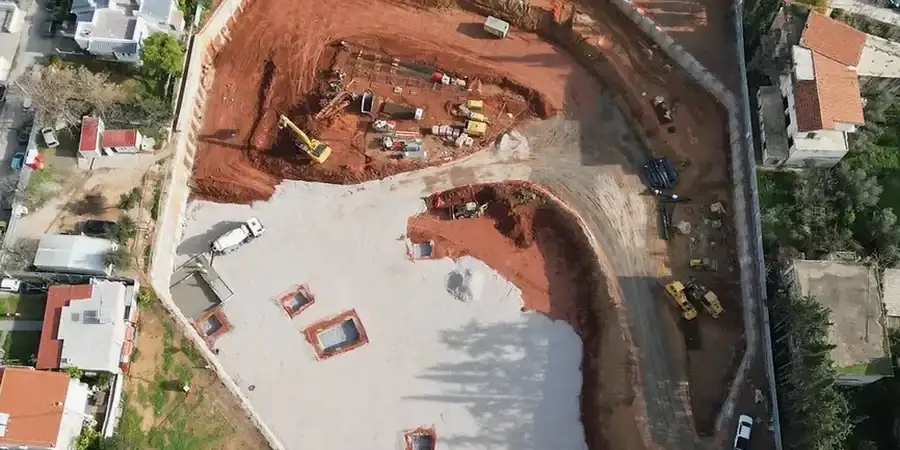
Glacial till in Bradford is notoriously variable — cobbles in stiff clay with sand lenses that create preferential groundwater flow paths.
Method and coverage
Regional considerations
Bradford expanded rapidly during the Industrial Revolution, and many of its deeper basements and canal structures were built without formal geotechnical records. The combination of historical mining in the coal measures to the south and the presence of made ground — often including brick rubble, ash, and industrial waste — creates a legacy of hidden voids and variable bearing conditions. When excavating close to Victorian-era terraces or the listed buildings in Little Germany, even modest ground movements can trigger structural damage. A solid monitoring regime using inclinometers and precise levelling is therefore integrated into every deep excavation design. The risk is managed through phased excavation, sequential propping, and real-time data feedback to the design team.
Standards that apply
BS EN 1997-1:2004 (Eurocode 7 – Geotechnical design), CIRIA C760 (Guidance on embedded retaining walls), NHBC Standards Chapter 4.2 (Building near excavations)
Complementary services
Basement and Shaft Design
Structural design of secant pile walls, diaphragm walls, and sheet pile cofferdams for excavations up to 15 m depth. Includes wall embedment, strut/bracing layout, and groundwater control measures.
Ground Movement Assessment
Prediction of settlement, heave, and lateral displacement using 2D and 3D finite element analysis (PLAXIS, Oasys). Calibration against local case histories from Bradford's recent infrastructure projects.
Typical parameters
Top questions
What is the typical cost range for a deep excavation design in Bradford?
Design fees typically fall between £1.660 and £7.240 depending on excavation depth, soil complexity, and the level of numerical analysis required. A simpler basement in uniform till may be at the lower end, while a deep shaft in mixed ground near heritage structures sits at the upper end.
How does glacial till affect the choice of retaining wall?
Glacial till's high stiffness and low permeability generally favour embedded retaining walls like secant piles or sheet piles. The presence of cobbles and boulders can, however, make pile installation difficult, and contractors often specify pre-boring or heavy duty vibratory hammers.
What groundwater control methods are recommended for Bradford's deep excavations?
Perched water tables within sand lenses in the till are best managed by sump pumping combined with cut-off walls. For deeper excavations below the water table, grout curtains or jet grouting may be needed to limit inflows. All designs comply with CIRIA C750.
Do I need a monitoring plan for an excavation near a listed building?
Yes. Bradford City Council's planning conditions typically require a detailed monitoring scheme for excavations within 10 m of listed structures. Inclinometers, precise levelling, and vibration monitoring are standard to ensure movements stay within acceptable limits.
What is the difference between a propped and an anchored retaining wall?
Propped walls use internal struts or waling beams within the excavation footprint, while anchored walls rely on ground anchors installed behind the wall. In Bradford's dense urban areas, anchors may be prohibited due to underground services or rights of way, making propped systems more common.