Many construction firms in Bradford underestimate the impact of the region's variable glacial till on rigid pavement performance. Specifying a slab thickness based solely on traffic class, without verifying the subgrade's California Bearing Ratio and potential for differential settlement, leads to premature cracking and joint faulting. A proper geotechnical investigation, including subrasante vial assessment to classify the foundation layer, is the first step toward a pavement that lasts. The city's legacy of millstone grit and boulder clay demands site-specific CBR testing rather than published default values, which often overestimate support capacity in wetter zones near the Aire Valley.
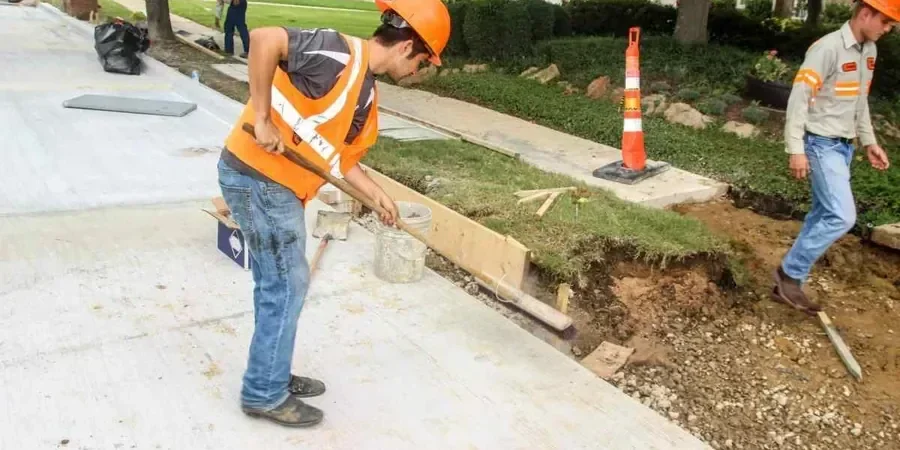
A CBR value taken from a single test pit in Bradford's glacial till can mislead the entire pavement design if the soil's moisture sensitivity is ignored.
Method and coverage
Regional considerations
A recent distribution centre project near the M606 interchange faced slab curling within six months because the rigid pavement design assumed a uniform k-value across the site. The contractor had not accounted for a buried channel of soft alluvium beneath the warehouse floor. This scenario is common in Bradford's floodplain areas where the underlying drift geology changes abruptly. Without a targeted investigation using trial pits and dynamic plate load tests, the design team cannot identify weak pockets that will cause joint stepping and loss of ride quality. The result is a costly overlay or partial demolition within the first year of service.
Process video
Standards that apply
BS EN 1997-2:2007 (Eurocode 7 – Ground investigation and testing), DMRB CD 226 – Design for new pavement construction (UK Highways), BS 5930:2015 – Code of practice for ground investigations, BS EN 13877-1:2013 – Concrete pavements – Materials
Complementary services
CBR Testing & Subgrade Classification
Soaked and unsoaked CBR tests on undisturbed samples, including laboratory compaction to BS 1377. Classification of glacial till, laminated clay, and made ground.
k-Value Determination (Plate Load Test)
In-situ plate bearing tests per BS 1377-9 to derive the modulus of subgrade reaction for rigid pavement joint design and base thickness calculation.
Frost Susceptibility Assessment
Grain size analysis and frost heave tests on subgrade soils. Identification of frost-susceptible silts and fine sands common in Bradford's valley bottoms.
Concrete Mix Design Verification
Flexural strength testing (third-point loading) on beam specimens to confirm the specified 28-day strength matches the pavement design assumptions.
Typical parameters
Top questions
What is the typical CBR value for subgrade soils in Bradford?
Bradford's glacial till typically yields soaked CBR values between 2% and 7%, though laminated clays in the Aire Valley can drop below 2%. Each site requires laboratory testing because the till's moisture content varies significantly with depth and drainage conditions.
How does rigid pavement design differ from flexible pavement design?
Rigid pavements distribute load through the slab's flexural strength and rely on the subgrade for uniform support (k-value), whereas flexible pavements spread load through granular layers. In Bradford, rigid designs are preferred for industrial yards with heavy point loads, as they resist rutting better but demand higher-quality subgrade preparation.
What is the cost range for a rigid pavement design study in Bradford?
A typical rigid pavement design study including site investigation, CBR testing, k-value determination, and slab thickness calculations ranges between £1.330 and £5.280, depending on the number of test pits and the complexity of the ground conditions.
Do I need a frost protection layer in Bradford?
Yes. Bradford lies in the UK frost zone where the design frost penetration depth is 450 mm. Without a non-frost-susceptible capping layer or a thicker slab, freeze-thaw cycles can cause slab heave in silty subgrades, especially in exposed upland areas near Haworth and Ilkley Moor.