Bradford grew fast during the Industrial Revolution, with mills and warehouses rising on glacial till and alluvial deposits along the Aire Valley. Much of the city centre sits on firm to stiff clays and gravels, but Victorian foundations were often shallow and undersized by modern standards. When we assess existing ground or design new footings, the plate load test (PLT) gives a direct measure of bearing capacity and settlement under real loads. Before mobilising the reaction frame, we always review borehole logs and couple the PLT with a calicata exploratory to confirm stratigraphy at the test depth. That combination avoids surprises when the plate bears on a thin crust over softer clay.
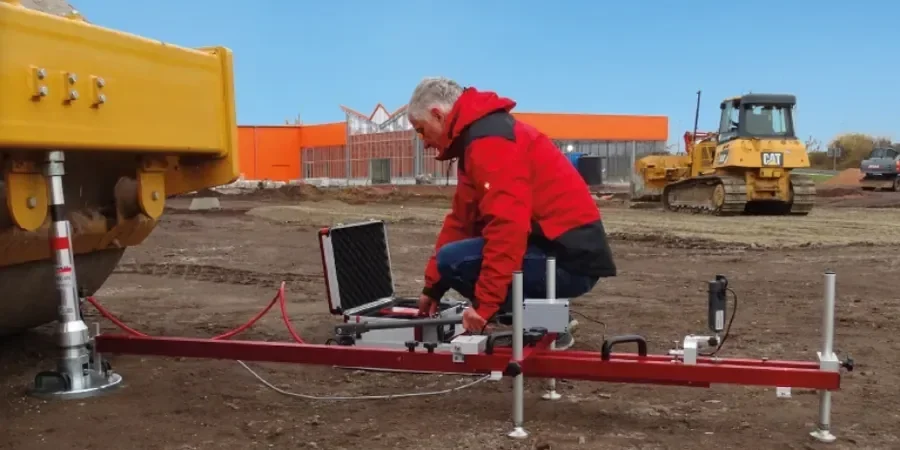
A single plate load test in Bradford’s glacial till can confirm design bearing pressures up to 300 kPa, but only if the test pit is dewatered and the plate bedded properly.
Method and coverage
Regional considerations
Glacial till in Bradford often contains cobbles and boulders that can tilt the plate or damage the bearing surface. If the plate beds on a single large stone, the load–settlement curve will overestimate stiffness and mislead foundation design. The water table also rises rapidly in winter; testing during wet months may require continuous pumping or a sump to keep the test pit dry. A saturated clay underneath the plate will consolidate during the test, producing creep readings that must be separated from primary settlement. Our procedure includes cyclic loading to identify these effects and report a reliable modulus.
Standards that apply
BS EN 1997-2:2007 (Eurocode 7 – Ground investigation and testing), BS 5930:2015 (Code of practice for ground investigations), BS 1377 (Standard test method for nonrepetitive static plate load tests), Manual of Contract Documents for Highways Works (MCHW) Series 600
Complementary services
Cyclic Plate Load Test
Repeated loading–unloading cycles to separate elastic from plastic deformation. Essential for pavement subgrade evaluation on the A650 corridor and for railway formation assessment in the Shipley Glen area.
Large-Diameter Plate Test (760 mm)
Used when the design footing is larger than 1.5 m and the soil fabric includes gravel lenses. The bigger plate averages local variations better and gives a modulus representative of the full foundation width.
Typical parameters
Top questions
What is the difference between a plate load test and a CBR test?
The CBR test measures the California Bearing Ratio – a relative index used for pavement design. A plate load test measures actual bearing capacity and modulus of subgrade reaction (k) under static load. For shallow foundation design in Bradford, the PLT is more relevant because it simulates the real footing pressure.
How much does a plate load test cost in Bradford?
Typical cost ranges between £590 and £1,070 depending on plate size, number of load cycles, and site access. Complex sites requiring dewatering or heavy reaction frames may exceed this range. We provide a fixed quotation after a brief site walkover.
Can the plate load test be performed on a slope or uneven ground in Bradford?
Yes, but the reaction system must be designed to avoid eccentric loading. On sloping sites like those near Heaton Woods, we use a temporary steel platform to level the plate. The test results remain valid as long as the plate bears flush on the prepared surface.
What modulus values can I expect from glacial till in Bradford?
For the firm to stiff boulder clay typical of the Bradford area, the reload modulus Ev2 usually ranges from 40 to 80 MPa. The modulus of subgrade reaction, k, falls between 50 and 120 MN/m³. These values are sensitive to moisture content, so we recommend testing in dry weather to avoid underestimating stiffness.