Bradford sits on a complex sequence of glacial till and laminated clay over Carboniferous Millstone Grit. The groundwater table fluctuates significantly across the Aire Valley, often within 2–3 m of the surface in low-lying areas. Retaining wall design in Bradford must account for these saturated, low-permeability soils to avoid hydrostatic pressure buildup behind the wall. Before finalising geometry, we recommend a soil classification study to confirm plasticity index and clay fraction. This data directly influences lateral earth pressure coefficients used in the design.
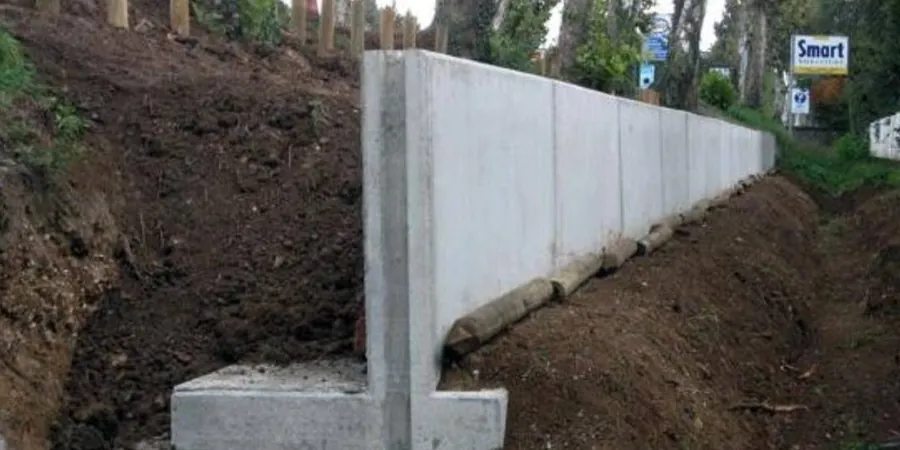
Saturated glacial till in Bradford can generate lateral pressures 40% higher than assumed in generic designs – site-specific testing is non-negotiable.
Method and coverage
Regional considerations
Bradford sits at an average elevation of 130 m above sea level, but the city centre lies in a valley prone to surface water runoff. Historical flooding events in 2015 and 2020 caused localised slope failures along Manningham Lane. Poorly designed retaining walls in Bradford have failed due to inadequate drainage and underestimation of lateral pressure from saturated backfill. We incorporate weep holes, drainage blankets, and granular backfill criteria to prevent these failures. A solid retaining wall design in Bradford must also consider the potential for differential settlement on the laminated clay deposits that underlie much of the urban area.
Standards that apply
Eurocode 7 (BS EN 1997-1:2004), BS 8002:2015 – Code of practice for earth retaining structures, BS 5930:2015 – Code of practice for ground investigations
Complementary services
Gravity and cantilever walls
Design of mass concrete, crib, or reinforced concrete cantilever walls for heights up to 5 m. We calculate sliding, overturning, and bearing resistance per Eurocode 7.
Embedded retaining walls (sheet piles, secant piles)
Analysis of embedded walls using limit-equilibrium and finite-element methods. We account for soil-structure interaction and groundwater flow around the toe.
Reinforced soil and anchored walls
Design of mechanically stabilized earth (MSE) walls and anchored systems. We verify internal stability, pullout resistance, and facing connection details.
Typical parameters
Top questions
What is the typical cost for retaining wall design in Bradford?
The cost for a full geotechnical design report with soil testing ranges between £790 and £3,520 depending on wall height, site access, and the number of boreholes required. This includes laboratory testing and a limit-state design report.
Do I need a retaining wall design if the ground slopes away from my house?
Yes. Even a gentle slope of 5° on Bradford's clay till can become unstable after heavy rain. A retaining wall design ensures the cut face is supported and drainage is managed so that water does not saturate the backfill.
How long does a retaining wall design take from site visit to final report?
Typically 3 to 5 weeks. Ground investigation drilling and lab testing take the first 2 weeks. The design calculations and report preparation require another 1 to 2 weeks. We can expedite if borehole logs from nearby sites are available.