Bradford sits on a complex mix of glacial till, alluvial deposits, and made ground, with elevations ranging from 50 m to 324 m above sea level. The city's industrial legacy left variable fill layers that can cause differential settlement if not properly assessed. Our raft/mat foundation design service addresses these challenges by distributing structural loads across a wide footprint, reducing bearing pressure on weak soils. We integrate site-specific ground investigation data with analytical methods to produce designs that meet Eurocode 7 requirements. Before finalising the slab geometry, we often recommend a complementary capacity de carga study to verify safe bearing values for shallow foundations.
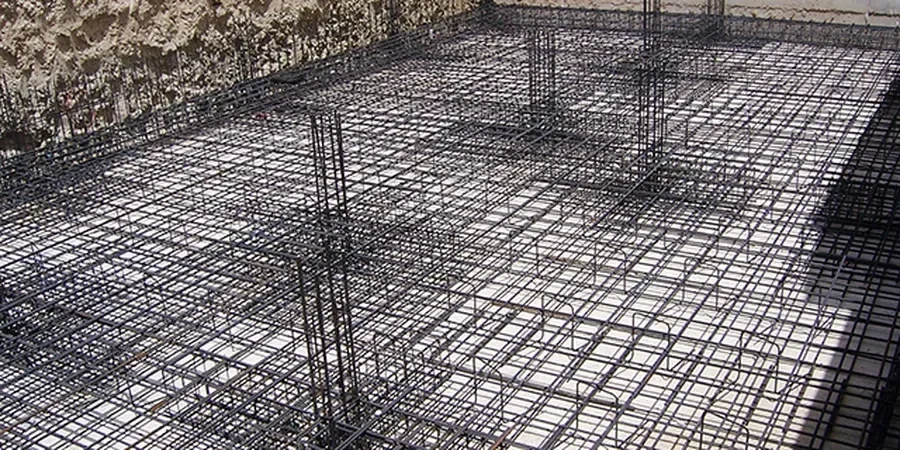
Variable glacial till and made ground in Bradford make uniform slab assumptions risky; site-specific analysis prevents costly differential settlement.
Method and coverage
- Load distribution analysis for multi-storey residential and commercial buildings
- Differential settlement checks using consolidation test data
- Reinforcement optimisation to avoid over-specification
- Integration with drainage and waterproofing details for high water table zones
Regional considerations
The Aire Valley beneath Bradford contains deep alluvial deposits and a high water table that fluctuates seasonally. Over much of the city, glacial till exhibits variable consistency from stiff clay to loose sandy silt. These conditions raise the risk of differential settlement, especially when structures span between natural ground and made ground. If the raft/mat foundation design does not account for these lateral stiffness changes, cracking in superstructure elements can occur. We mitigate this by performing phased settlement analyses and specifying Improvement where needed.
Standards that apply
Eurocode 7 (BS EN 1997-1:2004), BS 5930:2015 – Code of practice for ground investigations, BS 8004:2015 – Code of practice for foundations, CIRIA C580 – Embedded retaining walls and rafts
Complementary services
Ground Investigation Review & Interpretation
We review existing borehole logs, trial pit records, and laboratory test data to characterise the ground profile. This includes identifying soft layers, fill thickness, and groundwater regime for input into raft design calculations.
Finite Element Modelling of Raft Behaviour
Using software such as PLAXIS 2D/3D and SAFE, we simulate soil-structure interaction under serviceability and ultimate limit states. The model accounts for non-linear soil stiffness and the effect of adjacent excavations.
Settlement & Differential Movement Analysis
We calculate total and differential settlements using oedometer consolidation parameters and load distribution from the raft. The analysis checks compliance with structural tolerance limits specified by the project team.
Reinforcement Detailing & Construction Support
We produce detailed reinforcement schedules, bending moment diagrams, and construction stage notes. On-site support includes reviewing concrete pours, monitoring early-age cracking, and verifying compaction of sub-base layers.
Typical parameters
Top questions
When is a raft foundation better than strip footings in Bradford?
A raft foundation becomes the better choice when the allowable bearing capacity of the soil is low (typically below 100 kPa) or when differential settlement risks are high due to variable fill or soft alluvium. In Bradford's Aire Valley, where made ground and glacial till alternate within short distances, rafts distribute loads evenly and reduce the need for deep excavations.
How much does raft/mat foundation design cost in Bradford?
The typical cost for a full raft foundation design package, including ground investigation review, FE modelling, settlement analysis, and reinforcement detailing, ranges from £930 to £3,640 depending on building size, ground complexity, and number of load cases. A site-specific quotation is recommended after reviewing borehole data.
What ground conditions in Bradford most affect raft design?
The most challenging conditions are made ground with variable compaction, deep alluvial silts with high moisture content, and glacial till with pockets of soft clay. The seasonal water table rise can also reduce bearing capacity. We address these by incorporating drainage layers, adjusting slab thickness locally, and using Improvement methods such as stone columns where necessary.