Bradford sits on a mix of glacial till and fluvial terrace deposits. The till is stiff, heavily overconsolidated boulder clay. That makes driven piles a logical choice for deep foundations. But the clay's strength varies laterally. We have seen boreholes 20 m apart show completely different SPT profiles. A proper driven pile design must account for that variability. We always pair the pile analysis with an ensayo SPT to get reliable N-values at 1 m intervals. That data feeds directly into the shaft friction and base resistance calculations. Without it, you are guessing. And guessing on a brownfield site in Bradford – where old mill foundations and made ground are common – is risky.
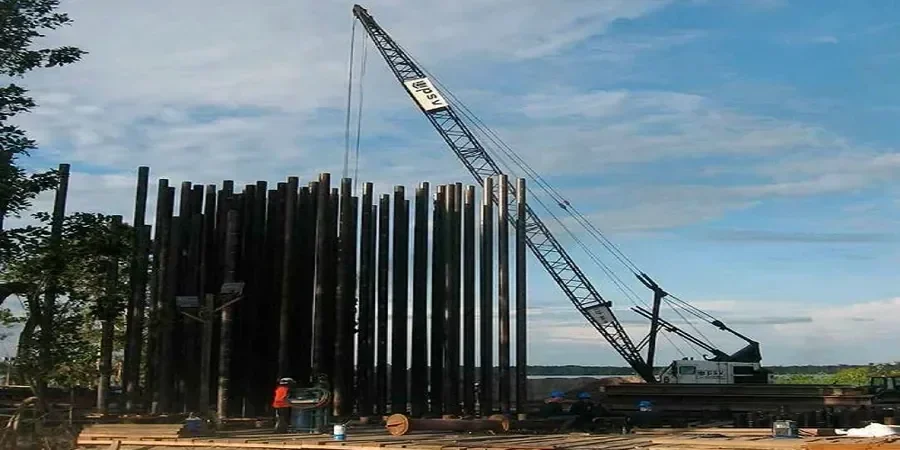
In Bradford's glacial till, driven pile capacity can double over a 5 m change in depth – the ground model must be site-specific.
Method and coverage
Regional considerations
Bradford sits at about 130 m above sea level on the eastern edge of the Pennines. The ground slopes toward the Aire Valley. That creates variable bedrock depths. Some sites have till overlying Coal Measures sandstone at 12 m. Others have 30 m of clay. The risk of negative skin friction on piles in made ground is real. So is the risk of pile refusal on boulders within the till. We have seen piles stop at 4 m on one side of a plot and drive to 10 m on the other. A driven pile design that does not include a thorough ground investigation will lead to cost overruns or structural issues.
Standards that apply
BS EN 1997-1:2004 (Eurocode 7 – Geotechnical design), BS 5930:2015 (Code of practice for site investigations), Institution of Civil Engineers – Specification for piling (SPERW)
Complementary services
Preliminary pile capacity analysis
Using SPT and CPT data from the site investigation, we estimate shaft friction and base resistance for common pile sections. We provide load-settlement curves and recommended working loads. The analysis follows Eurocode 7 DA1 and includes partial factors from the UK National Annex.
Drivability study and pile installation checks
We assess whether the chosen pile can be driven to the design depth without damage. This includes wave equation analysis (WEAP) and review of hammer energy, cushion, and soil set-up. For Bradford's till, we also check for refusal on cobbles and boulders.
Typical parameters
Top questions
What is the typical driven pile capacity in Bradford's glacial till?
For a 300 mm square precast concrete pile, we see working loads between 500 kN and 900 kN depending on the till's consistency and the pile length. End-bearing contributes about 30 % and shaft friction about 70 % in the stiff clay.
How much does a driven pile design study in Bradford cost?
A full design study including drivability analysis and load-settlement curves ranges between £1.020 and £3.080. The final cost depends on the number of pile locations and the complexity of the ground model.
Do I need a ground investigation before a driven pile design?
Yes. Eurocode 7 requires a ground model based on site-specific data. Without boreholes or CPT soundings, the design cannot be verified. We recommend at least one borehole per 200 m² of site area, with SPT tests every 1 m.
What pile material works best in Bradford's ground conditions?
Precast concrete piles are common because they resist the high driving stresses in the till. Steel H-piles are used where obstructions are expected. Timber piles are rare now – they decay above the water table, which is often shallow in the valley areas.