Many contractors in West Yorkshire assume a standard cement grout will seal any void. That belief has caused costly reworks in Bradford alone. Fissured Millstone Grit and old coal workings demand a tailored injection programme. Without a proper grouting design, grout can bleed into unseen fractures, wasting material and leaving gaps. We start with a field investigation to map permeability and joint spacing. Only then do we select the mix, pressure, and rheology. This approach prevents surprises during excavation. We often combine it with a slope stability analysis when the work involves cutting into hillsides where water ingress is a known risk.
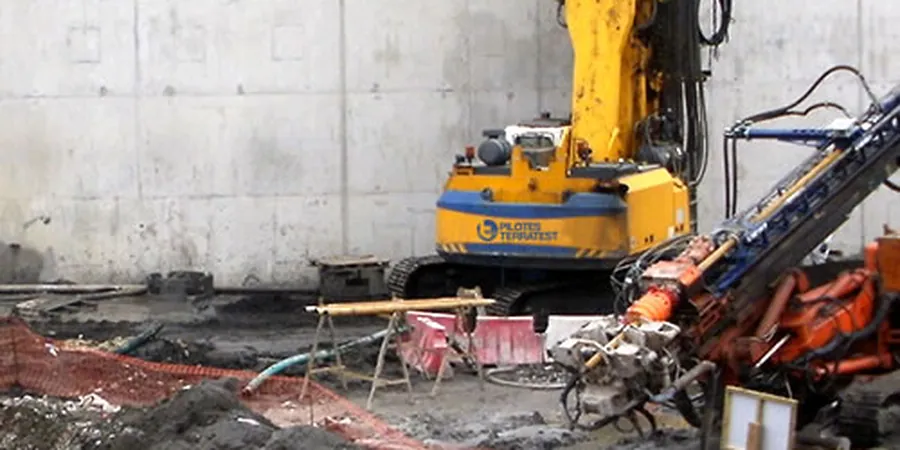
Void volume in Bradford’s former mining zones can reach 15% of the rock mass. Without a precise grouting design, that void stays open.
Method and coverage
Regional considerations
The Coal Measures underlying Bradford contain unrecorded adits and bell pits from the 18th and 19th centuries. One collapsed shaft can drain grout for hours without any pressure buildup. That is a direct loss of material and time. More critically, untreated voids may propagate under heavy loading, leading to differential settlement of new foundations or road slabs. We map these hazards using historical mine plans and geophysical surveys before designing the grouting layout. The injection sequence must follow a primary, secondary, and tertiary pattern to avoid leaving untouched zones between grouted columns.
Standards that apply
BS EN 12715:2000 – Execution of special geotechnical work – Grouting, BS 5930:2015 – Code of practice for ground investigations, Eurocode 7 (BS EN 1997-1:2004) – Geotechnical design
Complementary services
Void-Fill Grouting for Mining Areas
Designed for old workings under residential and light industrial sites. Uses high-mobility cement grout with fly ash to reduce shrinkage. Each injection phase is monitored with flowmeters and pressure transducers to confirm complete fill.
Permeation Grouting in Fissured Sandstone
Applied to reduce water inflow during basement or tunnel excavation. Low-viscosity polyurethane resin seals joints from 0.2 mm width. Injection points are spaced at 1.5 m centres, with verification coring taken after curing.
Compensation Grouting for Settlement Control
Used beneath existing structures when new excavation alters ground support. Grout is injected in controlled pulses to raise or stabilise foundations. Real-time tilt monitoring ensures movement stays within 5 mm tolerance.
Typical parameters
Top questions
How long does a typical grouting design project take in Bradford?
Site investigation and mix design take two to three weeks. Execution time depends on volume, but a standard 100 m² treatment area can be completed within five working days.
What is the cost range for a grouting design in West Yorkshire?
A full design-and-inject package for a typical Bradford site falls between £1,030 and £2,860. Final cost depends on access, depth, and the type of grout selected.
Do you guarantee that all voids are filled after grouting?
We design the injection sequence to achieve 95% void fill based on calculated volume. Post-treatment verification using cross-hole tomography or core drilling confirms residual voids before sign-off.
Can grouting be performed during wet winter months in Bradford?
Yes. We use fast-setting chemical grouts that cure even in saturated conditions. The work programme accounts for higher groundwater levels typical between October and March.