In Bradford, the underlying geology is predominantly Carboniferous Millstone Grit with superficial glacial till and alluvial deposits along the Aire Valley. When we receive a client's sample at the lab, the first thing we notice is the variability in gravel content and fines plasticity from one site to the next. That is why running a Proctor test in Bradford requires a well-defined selection between Standard (BS 1377-4:1990) and Modified (BS 1377-4:1990) compaction energies. The standard method is adequate for lighter fills and garden terraces, while the modified version replicates the heavier compaction of highway embankments and deep structural backfills. Before compacting the sample, we always cross-check its natural moisture content and particle size distribution with a granulometry analysis to confirm the fraction passing the 20 mm sieve is sufficient for the test.
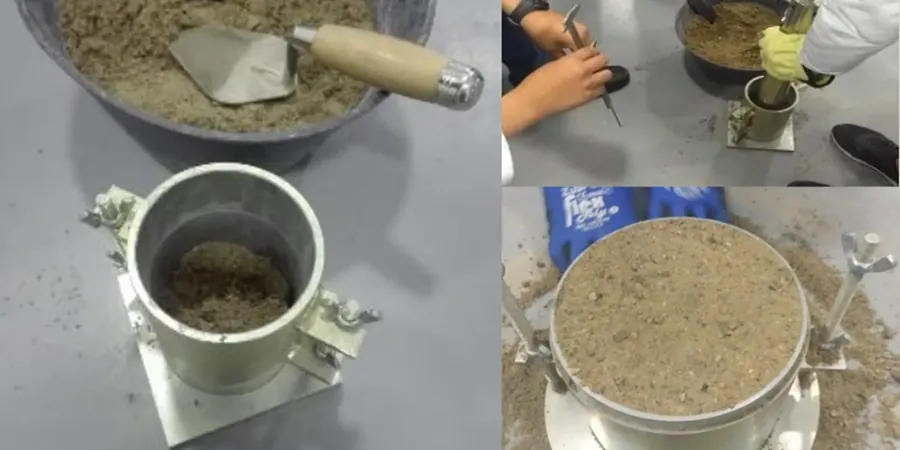
A Proctor test tells you exactly how much water and energy your soil needs to reach its maximum density — no guesswork.
Method and coverage
Regional considerations
A residential development on former railway land off Manchester Road in Bradford required a 3 m high embankment to level the site. The contractor had assumed a uniform sandy gravel based on visual inspection and proceeded with compaction using a standard vibrating roller. After failing the field density check, we ran a Proctor test in Bradford on the actual fill material and found the optimum moisture content was 4% higher than the as-placed value. That mismatch caused a 6% drop in dry density, leading to differential settlement concerns. The solution was to adjust the water addition at the borrow pit and increase the roller passes. Without that laboratory data, the embankment would have remained under-compacted and prone to long-term settlement.
Process video
Standards that apply
BS 1377-4:1990, BS EN 13286-2:2004, Eurocode 7 (EN 1997-2:2007)
Complementary services
Standard Proctor Test (BS 1377-4)
Determination of maximum dry density and optimum moisture content for general fills, garden terraces, and light structural backfills. Suitable for soils up to 20 mm particle size.
Modified Proctor Test (BS 1377-4)
Higher energy compaction test for highway embankments, deep backfills, and heavy earthworks. Designed for soils up to 20 mm particle size, often used in road construction and large infrastructure projects.
Typical parameters
Top questions
What is the difference between Standard and Modified Proctor tests?
The key difference is the compaction energy applied. Standard Proctor uses 596 kJ/m³ with a 2.5 kg rammer, while Modified Proctor uses 2682 kJ/m³ with a 4.5 kg rammer. The modified test simulates heavier compaction equipment and is typically specified for highway embankments, deep fills, and structural backfills. Standard Proctor is adequate for lighter fills, garden terraces, and domestic retaining walls.
How much does a Proctor test cost in Bradford?
The typical cost for a Standard Proctor test ranges between £90 and £130. A Modified Proctor test is usually priced between £120 and £170. These prices include the compaction curve and report. Volume discounts apply for multiple samples from the same project. Contact us for a precise quotation based on your scope.
Do I need a Proctor test for every soil type?
Not always. Granular soils with low fines content, such as clean sands and gravels, often achieve near-maximum density with minimal control. However, cohesive soils — clays and silts — and mixed fills like the glacial tills common in Bradford require a Proctor test to establish the target density and moisture window. For very gravelly soils, a large mould (CBR mould) may be required.