Bradford's varied geology, from glacial till over Coal Measures to alluvial deposits along the Aire Valley, means subgrade conditions can change drastically within a single street. The team regularly sees sites where a stiff clay layer sits just two metres below soft made ground, demanding a careful assessment before any pavement design begins. A thorough classification of soils helps identify the exact material types present, while CBR testing provides the bearing capacity values needed for thickness design. Without this data, flexible pavements risk premature rutting or cracking in Bradford's freeze-thaw cycles.
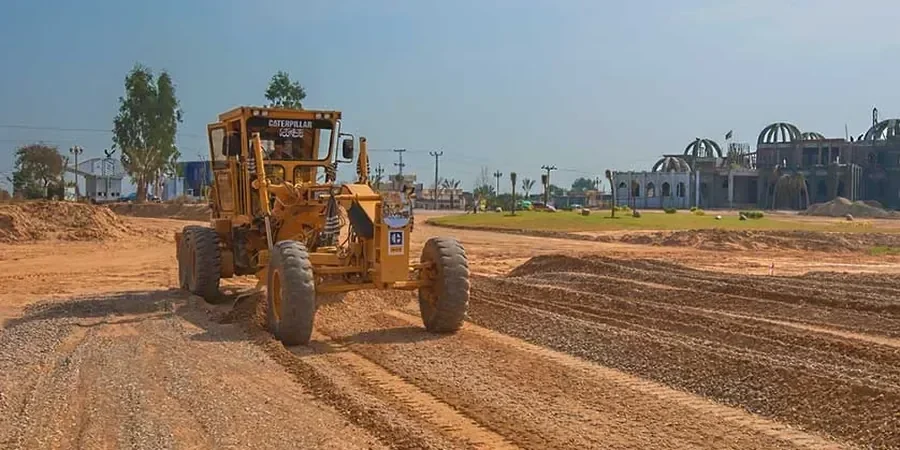
One metre of glacial till in Bradford can vary from stiff clay to loose sandy silt — subgrade design must account for that lateral variability.
Method and coverage
Regional considerations
A recent housing estate access road in Thornton, Bradford, suffered over 40 mm of differential settlement within two years because the subgrade design assumed uniform CBR of 5% across the site. The reality was a soft clay pocket near a former mill pond that dropped to 1.5% CBR after a wet winter. That single oversight cost the contractor £120,000 in remedial pavement reconstruction. For Bradford's industrial estates and residential developments, a phased investigation with trial pits and CBR testing at each geological unit prevents exactly this kind of failure.
Process video
Standards that apply
BS 5930:2015 — Code of Practice for Site Investigations, Eurocode 7 (EN 1997-1:2004) — Geotechnical Design, BS 1377-4:1990 — Methods of Test for Soils (Compaction-related tests), HD 25/26 (DMRB) — Pavement Design for UK Highways, BS 1377-4 — Standard Test Method for CBR
Complementary services
CBR Testing (Soaked & Unsoaked)
Laboratory CBR tests on remoulded or undisturbed samples following BS 1377-4, including both soaked (4-day swell) and unsoaked conditions to match seasonal moisture changes typical of West Yorkshire clays.
Compaction Control & Proctor Testing
Standard and modified Proctor compaction tests to determine optimum moisture content and maximum dry density, essential for earthworks quality control on Bradford road schemes.
Subgrade Modulus Evaluation
In-situ plate load tests (BS 1377-9) and correlation with CBR values to derive Ev2 modulus for pavement design, particularly important where heavy haulage routes cross Bradford's industrial zones.
Typical parameters
Top questions
What CBR value is typically expected for glacial till in Bradford?
For stiff glacial till common across Bradford's higher ground, soaked CBR values range from 3% to 8%, with unsoaked values reaching 10-15%. However, alluvial deposits near the River Aire can drop below 2% soaked, requiring either Improvement or thicker pavement construction. The specific value depends on clay content, moisture condition, and compaction effort.
How much does a full subgrade investigation for a Bradford road project cost?
A standard investigation package including trial pits, CBR testing, and Proctor compaction for a typical residential street runs between £860 and £2,240, depending on site access, number of test locations, and whether soaked testing is required. Larger industrial estate roads with multiple geological units will be at the upper end. Contact the laboratory for a fixed quotation based on your project scope.
Is soaked CBR testing always necessary for Bradford's climate?
Given Bradford's average annual rainfall of over 900 mm and the high plasticity of local clays, soaked CBR testing is strongly recommended for any pavement designed to last more than 10 years. The 4-day soak simulates winter moisture saturation, which can reduce bearing capacity by 40-60% compared to summer-dry conditions. For minor access roads or temporary haul routes, unsoaked testing may suffice, but the designer should apply a reduction factor.