Bradford's position in the Aire Valley means much of its urban fabric sits on glacial till overlying Carboniferous Millstone Grit, with soft alluvial deposits near the river corridors. These variable ground conditions demand a geocell design that accounts for differential settlement and low bearing capacity in the upper 2–3 metres. We integrate site-specific soil parameters from our own corte directo tests to calibrate the confinement model, ensuring the geocell system delivers the predicted performance under repeated loading from construction traffic or service vehicles.
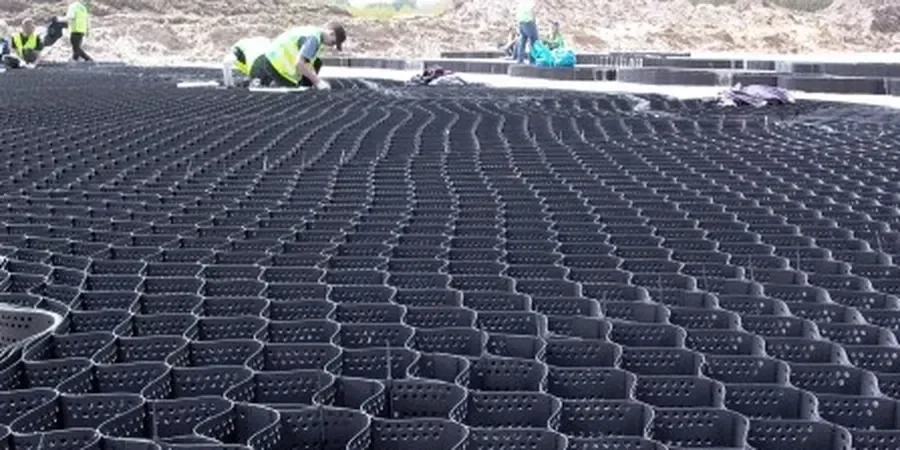
A properly designed geocell in Bradford's soft alluvium can triple the bearing capacity of the untreated subgrade, reducing the required pavement thickness by up to 40%.
Method and coverage
- We run triaxial simulations on the confined soil to estimate the modulus improvement factor.
- Peak particle velocity limits from nearby vibro-compaction are checked against BS 7385.
Regional considerations
A common error we see in Bradford is treating the geocell as a universal fix without checking the subgrade's moisture regime. Contractors lay the geocell on wet alluvium, fill it with crushed rock, and then wonder why the system sinks. The real issue is that the geocell cannot drain the underlying soil. You must first install a capillary break or a geomembranas separation layer. Without that, the geocell simply becomes a floating mat that settles unevenly under the first heavy load.
Process video
This service complements our laboratory testing work for a complete project analysis.
Standards that apply
BS 5930:2015 (Code of practice for ground investigations), Eurocode 7 (EN 1997-1:2004) – geotechnical design, BS EN 14475:2006 – execution of geotechnical works (reinforced fill)
Complementary services
Geocell for Access Roads and Haul Routes
Design of geocell-reinforced platforms for temporary construction access over soft ground. We use the Giroud-Han method modified for the low CBR values typical of Bradford's floodplain clays.
Slope Stabilisation with Geocells
Analysis of shallow rotational failures on embankments up to 6 m high. The geocell provides tensile resistance at the interface, and we check internal stability per BS EN 14475.
Basal Reinforcement for Embankments
Geocell placed at the base of new highway or railway embankments to spread the load and limit differential settlement. We incorporate pore-pressure dissipation rates from the site's consolidation tests.
Typical parameters
Top questions
How does geocell design differ for Bradford's glacial till versus its alluvium?
On glacial till the geocell primarily controls lateral spreading and provides a working platform, while on alluvium the design must address bearing failure and deep settlement. We adjust the cell depth and fill gradation accordingly.
What is the typical cost range for a geocell design study in Bradford?
A full geocell design with site-specific parameters and a written report typically ranges between £630 and £1,910, depending on the number of design sections and the complexity of the subgrade conditions.
Can geocells be used on slopes steeper than 1:2 in Bradford?
Yes, but we must check the interface shear between the geocell and the underlying soil. We run direct shear tests with the geocell material to verify that the friction angle exceeds the slope angle by at least 5 degrees.
How do you account for the high water table in the Aire Valley?
We model the geocell as a partially drained system. The design assumes that the water table can rise to within 0.5 m of the surface, and we specify a non-woven geotextile underneath to separate and filter without blocking drainage.
What fill material works best for geocells on Bradford's soft soils?
A well-graded crushed rock (maximum particle size 50 mm) with less than 5% fines gives the best interlock and confinement. We avoid single-sized gravel because it allows the geocell walls to buckle under load.